



Macro-Environment Leads to Price Discount and Opportunity
October Correction Does Not Reflect Adoption Progress
We believe a perfect storm of sharply higher interest rates, the midterm outcome, and the Binance hack drove the selloff. None of these events, even when adding in the whirlwind of questions around Nvidia, change our long-term outlook, and if anything, we expect a sharp reversal in 2027. Why?
- Higher rates and labor costs have caused cost overruns and funding challenges, but the bubble argument ignores the efficiencies that AI delivers, which arguably will also be deflationary.
- Data center demand far outstrips what can come online in 2027 and 2028, which is lifting near-term compute rates. Politicians pushing moratoriums want a better lifestyle for constituents, and we believe that will come through taxation on the future profits from data centers. AI is a bipartisan mission, and America cannot afford to fall behind in the technology revolution.
- The midterms went against Republicans, but accelerating adoption and tokenization-driven efficiencies should let bipartisan benefits outweigh political friction. Democrats have two years to show progress, and we may be entering a world where support comes through compromise.
- The $6.3 billion Binance hack came just as the asset class looked ready to leave its bear market. Using Bitcoin as the proxy, most are watching $73,000 (the 200-day average) first, with a possible low near $60,000 for added technical support. Downside tests are never fun, but they build credibility for the asset class. Also, on a risk/reward basis, while the asset class now looks like it is experiencing a correction, the risk/reward looks quite compelling.
Binance: The Largest Hack on Record
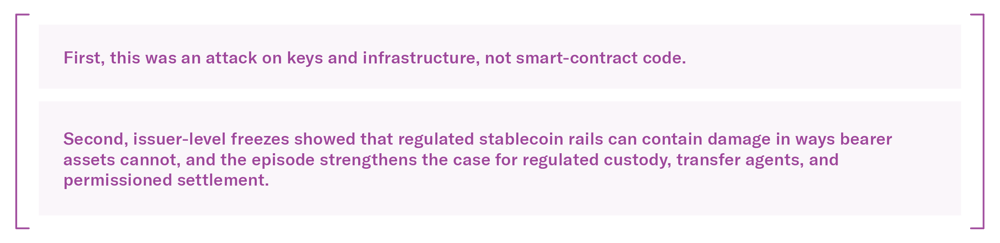
On October 29, an attacker moved about $6.3 billion out of Binance wallets across ten blockchains, mostly within 20 minutes. TRM Labs attributed the attack to North Korea's TraderTraitor unit, the group behind the 2025 Bybit theft, and Chainalysis said it appeared to be the same group's work. Binance said about $3 billion was frozen onchain almost at once with help from partners, including Circle, Tether, and Ripple, and that it set aside more than $6.3 billion of company funds to cover losses.
Two Takeaways
DTCC and NYSE Move Tokenization Forward
On October 28, the Depository Trust Company went live with the DTCC (Depository Trust & Clearing Corporation) Tokenization Service. Eligible participants can mint tokenized entitlements to select DTC-held securities, move them to registered digital wallets, and convert them back. The tokens keep the ownership rights, investor protections, and economic entitlements of the underlying securities. DTC is not a startup testing a parallel record; it is a core market utility with more than $114 trillion in assets under custody.
Twenty DTC participants had signed access agreements at launch, including Bank of America, Citi, Fidelity, JPMorgan, Morgan Stanley, and UBS, and more than 150 firms contributed through an industry working group. The initial universe includes selected Russell 1000 equities, major index ETFs, and U.S. Treasuries, on networks including Canton and Hyperledger Besu. This is measurable adoption and evidence that the system is finally being upgraded; how business develops around it remains to be seen.
The key feature for investors is convertibility between traditional and tokenized forms, which preserves the existing legal and custody framework while allowing faster movement, trading outside banking hours, and use as collateral in new workflows. The economics likely sit across custody, transfer agency, collateral management, lending, trading, shareholder relations, data, and compliance.
The NYSE post-month-end developments add another layer of progress. On November 2, NYSE named Broadridge (BR), Computershare, Equiniti, and Superstate as transfer agent partners for its planned tokenized securities venue, joining Securitize (SECZ) and zero (38% owned by NXH). It remains an announced platform, like Nasdaq, subject to regulatory approval, not live volume, but the progress is visible. Nasdaq, not to be outdone, also has its own competing tokenization strategy.
We, of course, would expect tokenization to have a meaningful impact on companies like Coinbase, Robinhood, and Circle, but for now, the revenue growth for these companies is very much tied specifically to traditional trading volumes.
Amplify Blockchain Technology ETF: BLOK
BLOK declined 16.13% on net asset value in October, reversing the Fund's third quarter gains and leaving the Fund down 9.76% year-to-date for the first ten months of 2026. The drawdown reflected broad weakness across the digital asset class rather than a single company event. View standardized performance.
The operating evidence moved the other way. DTCC, which holds more than $114 trillion in assets, launched a production tokenization service. Robinhood (HOOD), Coinbase Global (COIN) and Circle Internet Group (CRCL) showed measurable blockchain activity and revenue. Applied Digital (APLD), Core Scientific (CORZ) and Hut 8 (HUT) showed meaningful infrastructure revenue ramp. Portfolio companies in the data center category announced deals worth well over $100 billion between hyperscale’s. This also includes announcements worth $19 billion Google backstop agreement with TeraWulf and a $28 billion deal between Riot Platforms (RIOT) and Anthropic.
Data Center Results Improve While Balance Sheet Risk Remains
BLOK’s data center holdings, which total eight, produced strong operating evidence as power is just beginning to come online. The common focus currently across our diversified holdings in the space is investment grade leases and/or backstops that ultimately support valuations that are exponentially higher than their current values. Power will remain a scarce resource, in our judgement, through 2028. As examples, here are four tidbits.
- Core Scientific (CORZ) delivered the most advanced high-performance computing (HPC) ramp, reporting Q3 total revenue of $232.9M with colocation revenue, (which is leasing of data center space, power, cooling, or infrastructure), of $215.4M, up 58% sequentially and 14.4x year-over-year, as billed power capacity grew by 90 megawatts (MW) in the quarter to 485 MW, representing more than $700M of annualized colocation revenue. Core Scientific's total contracted capacity stood at approximately 1.1 (gigawatts)GW across CoreWeave and AMD, forecast to generate more than $24 billion in revenue over the contract terms.
- Applied Digital (APLD) reported the largest absolute revenue figure in the category, fiscal Q1 2027 revenue of $341.9M, up 322% year-over-year, with live HPC capacity at Polaris Forge 1 reaching 250 MW on October 1 after the second 75 MW phase came online, and total contracted capacity of approximately 1.41 GW across five campuses representing ~$36B of contracted revenue.
- Tera Wulf (WULF) reported Q3 revenue of $76.2M, with HPC lease revenue of $63.0M representing 83% of total revenue and growing 8.7x year-over-year, as 102 MW of critical IT capacity at Lake Mariner generated rent at quarter-end.
- Galaxy Digital (GLXY) reported Q3 data center leasing revenue of $79.1M, its first full quarter of Helios Phase I contribution from 133 MW in operation, with data center adjusted EBITDA of approximately $70M at a 78.4% margin, up from $11.5M and a 44.3% margin in Q2. Management guided to an annualized leasing revenue run rate of $800–$850M exiting 2027 as 600 MW of incremental capacity across Helios Phases II and III comes online.
Attribution
The data center group averaged a -31% return for the month, with dispersion ranging from CIFR (-53.93%) at the worst to CORZ (-17.08%) at the mildest. The selloff was broad and correlated, but that does not mean that there are no significant differences between these companies. Geography, selected tenants, power strategy, and capital structure are key differences. We have tracked these stocks for nearly a decade and have had a great deal of dialogue with management. CIFR was the standout detractor, detracting 1.92% from the Fund, despite being only the 7th-largest position by weight, reflecting the extreme beta of pure-play Bitcoin miners to spot price moves. GLXY (-1.08%) and HUT (-1.10%) were the next-largest drags, given their combination of meaningful weight and high drawdowns.
FIGR (-25.20%) was a notable individual detractor at -1.00%, the position averaged 3.77% weighting throughout the month. Robinhood (HOOD) subtracted -1.07% after reporting declining profit that missed Wall Street expectations, with its cryptocurrency business described as mired in a yearlong slump.
On the positive side, IBM gained 0.39% after reporting Q3 revenue of $17.10B against a $16.83B estimate, with software growing +8.3% year-over-year, and reaffirming full-year constant-currency revenue growth of +4% to +5%. Customers Bancorp (CUBI) added 0.27% after beating Q3 EPS ($2.27 vs. $2.14 estimate). Visa (V, +15.10%) and Mastercard (MA, +15.86%) each contributed positively, benefiting from rotation into traditional financial names away from crypto and AI-exposed tech.
|
Transaction and Repositioning: We came into the month with some strategic cash in reserve, which is consistent historically with how we manage through turbulent times. As an active Fund, we tend to make more changes to the portfolio during these times, as we see both price as an opportunity and consider how we see the leadership in the space coming out of a down cycle. Sources of cash sometimes also come from non-core positions that are strategically positioned for defense. In the month of October, we trimmed back IBM, AMD, and BlackRock as sources of funds. We also trimmed international exposure in SBI Holdings (8473 JT) and NU Bank (NU). We also sold out of Sharplink (SBET) completely. In total, we made six sells. Conversely, our buys were in CLSK, CIFR, CORZ, GLXY, RIOT, FIGR, CRCL, BULL, ETH, NHX, and PURR. Bullish (BLSH) was added as a new position, and, like all these moves we made changes incrementally in the range of 0.25%-0.75%. In drawdowns, over the years, we have learned that getting the price right sometimes takes patience, so we move intentionally. All these changes did not materially affect our cash position, and we expect to continue to be targeted in our repositioning, because we aim to capture the rebound. |
Summary
October was a sharp reminder that blockchain equities remain volatile and correlated in risk-off periods, but it also produced the strongest institutional infrastructure evidence of 2026: DTCC moved to production, the SEC described an operating path for tokenized stock venues, and NYSE assembled partners for a regulated platform. The most durable opportunity may not be a single token, but the migration of custody, transfer agency, trading, collateral, payments, and settlement onto programmable infrastructure.
Active management means owning companies that control distribution, provide regulated infrastructure, and convert usage into future cash flow, while also knowing how to pivot when opportunities change. Volatility can be difficult to avoid, but over the long term, we believe our approach has facilitated participated in market rebounds.
Arguably, this proves the value of staying true to our mandate.
The next phase is about conversion. We will be watching whether tokenized assets are used repeatedly, whether payment and collateral volume becomes recurring, whether companies disclose fees and margins, and whether data center contracts become funded construction and cash flow.
Education
- Podcast: Tokenized. 160 Episodes on stablecoins, tokenization, and real-world assets. November 2026.
- Whitepaper: Hyperliquid Strategies Inc.. Introduction to Hyperliquid. November 2026.
- Whitepaper: Satoshi Nakamoto. Bitcoin: A Peer-to-Peer Electronic Cash System. October 31, 2008.