



Blockchain Convergence with AI
As of January 31st, BLOK is up 4.48% year-to-date for 2026 (NAV returns, see standardized performance) but headwinds surrounding the uncertainty around the Market Structure bill or also known as Clarity Act1 and the U.S. government brief shut down gave investors a reason to pause and suddenly go risk off. We acknowledge that this volatility is hard to stomach but believe that long-term investors will be rewarded by owning the companies building out the infrastructure. Moreover, whether crypto trades like it is in a bear market (aka, a “Winter”) we see the technology buildout on blockchain rails as accelerating in 2026 and converging further with Artificial Intelligence (AI).
Skeptics around the benefits of blockchain should read the explanation by Mike Cagney, CEO of Figure (FIGR) why Fannie Mae or Freddie Mac with their legacy systems are challenged to structure a $300,000 loan due to $13,000 of costs. In contrast, on Figure’s (FIGR) platform loans are originated with a shared revenue benefit to the regional banks which are able to fund the loans off their balance sheets at meaningful lower cost than the platforms built on legacy bureaucratic government infrastructure. Bottomline, as Cagney stated on February 9, 2026, “lawmakers or regulators” should support crypto progress as blockchain has the potential to solve the affordability problem for home ownership. The legacy infrastructure needs an upgrade.2
We believe the technology stack that will enable the convergence between AI and blockchain will lead to the integration between blockchain and data centers, but admittedly this buildout will take years and trillions of capital. Based upon recent earnings calls, we know that some $700 billion has been committed by Amazon (AMZN), Alphabet (GOOG), Microsoft (MSFT), Nvidia (NVDA), Oracle (ORCL), but there are many that are also privately supporting this buildout; and, arguably these large companies leading this buildout cannot afford to be poorly positioned for this transition. The scale of these projects is so large and the transformation of business by AI is so evolutionary that even at the expense of dilution there is little choice but to embrace the change. Larry Ellison speaks to the importance of this technological evolution broadly, but the action to tap the equity markets for the first time in 40 years demonstrates that this transformation is about the firm’s ability to thrive in the new world as he envisions it.
The integration between AI and blockchain involves the security of data integrity on the chain. Blockchain provides a secure, tamper-proof environment for AI data which foundationally can be trusted because it is more traceable from the transparent logs of the ledger on the blockchain. To this point, as AI models are run on a distributed decentralized network as smart contracts, self-executing program on a blockchain that automatically enforces an agreement when present conditions are met, they provide more data control and privacy.
The performance data quoted represents past performance and does not guarantee future results. Investment return and principal value of an investment will fluctuate so that an investor’s shares, when sold or redeemed, may be worth more or less than their original cost. Current performance may be lower or higher than the performance quoted. For most recent month-end performance, visit BLOKETF.com.
In our December letter we referred to Regulation, Adoption and Capital (RACs) as a framework to track the investment conditions. Reporting on RACs progress on a monthly basis has its challenges, as monthly metrics can foster short-term thinking, but we hope the acronym helps frame honest engagement and education around this space.
|
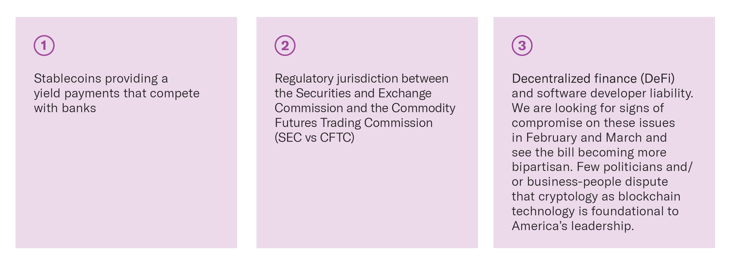
Regulation The Market Structure Bill, otherwise known as the Clarity Act, was openly debated throughout January, culminating in a visit by Crypto leaders at the White House. Key issues remain focused on:
|



|
Adoption New Survey from PayPal and the National Cryptocurrency Association shows accelerating merchant adoption driven by customer demand.3
|


|
Capital Markets were open for business, but admittedly the BitGo IPO proved disappointing. Nevertheless, we remain constructive on the capital markets and see Cipher (CIFR) raising $2 billion through the debt markets as contrasting support within our portfolio. Our understanding was that the deal was heavily oversubscribed.
|


|
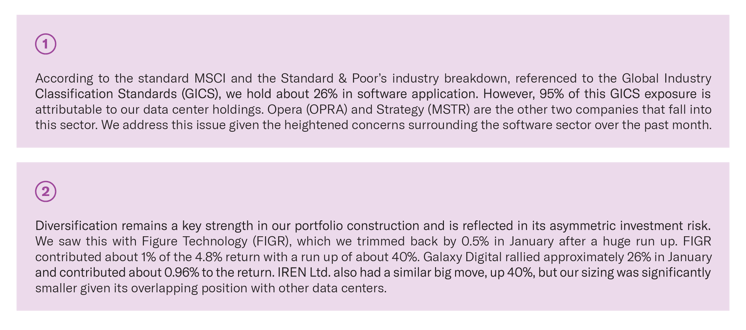
Attribution In January, BLOK’s NAV returns were up 4.48% year to date (YTD), remaining meaningfully ahead of the broad indexes, Bitcoin, and other thematic portfolios; however, performance was choppy. We highlight two points in our outlook for 2026.
Diversification does not assure a profit or protect against a loss in a declining market. Headwinds in January came from companies like BitGo (BTGO), which declined approximately 30% to around $12.60. Obviously not a strong start for an IPO priced at $18. Other weak-performing names included Roblox (RBLX) and Circle Internet Group (CRCL), both of which declined approximately 19%; however, neither of which had a meaningful impact on the portfolio return since they were sized small. Platform companies like Robinhood (HOOD), Coinbase (COIN), eTORO (ETOR) in aggregate were headwinds of about 1% all together. |
|
Transactions and Repositioning As a matter of discipline, we trimmed our position in Figure Technology (FIGR) by about 0.5% following a move of over 150% from the IPO price. As a reminder, the company went public back in September and is currently working through the tokenization of its own stock and the unlocking of insider shares. We also sold out of 100% of our position in GameStop (GME). In the absence of additional clarity by Management around its business prospects, their ownership of Bitcoin and the board’s irresponsible decision to provide an audacious compensation package we just did not see an alignment in interests. |
1Clarity Act is a bill designed to create regulatory framework for digital assets
2Mike Cagney Twitter https://x.com/mcagney/status/2020966025228156975?s=20