



The Bridge Between Crypto and Your Wallet
Introduction: The Problem with Crypto “Money”
When Bitcoin was introduced, it was envisioned as a global payment system. However, one fundamental problem has kept it from being used for everyday purchases: extreme price volatility. Imagine trying to buy a coffee with a currency whose value could swing from $100,000 to $80,000 in a single day. This unpredictability makes it impractical for daily transactions and is why Bitcoin is largely treated as a speculative investment, similar to digital gold, rather than a functional currency. Like gold, its value is derived from supply, demand, and perception, not from being backed by a tangible asset. This volatility created a clear need for a new kind of digital money that could solve real-world financial problems without the wild price swings.
What is a Stablecoin?
A stablecoin is a type of cryptocurrency specifically designed to maintain a stable value by being “pegged” to a real-world asset. This peg is the key difference between a stablecoin and a volatile cryptocurrency like Bitcoin, which derives its value purely from supply and demand. By linking its value to a tangible asset, a stablecoin provides a reliable and predictable digital currency.
Stablecoins can be pegged to a variety of real-world assets, including:
- Fiat Currencies: Most commonly, the US Dollar.
- Commodities: Such as gold.
- Financial Instruments: Like government bonds.
A Note on “Algorithmic” Stablecoins – It’s important to distinguish between stablecoins backed by real assets and those that are not. In the past, “algorithmic” stablecoins attempted to maintain a peg using complex algorithms. However, by the definition used here, these are not real stablecoins; they are a more sophisticated form of Bitcoin itself. The infamous Terra/Luna scandal, which resulted in massive financial losses for many, was a cautionary tale about the inherent instability of this algorithmic model. A stablecoin, by definition, must be pegged to a real, verifiable asset.
Now that we know what a stablecoin is, let’s explore the mechanics of how this peg is actually maintained.
How Do They Work? A Look Under the Hood
The stablecoin market is dominated by two major players, USDT (Tether) and USDC (Circle), which together command approximately 90% of the market share.
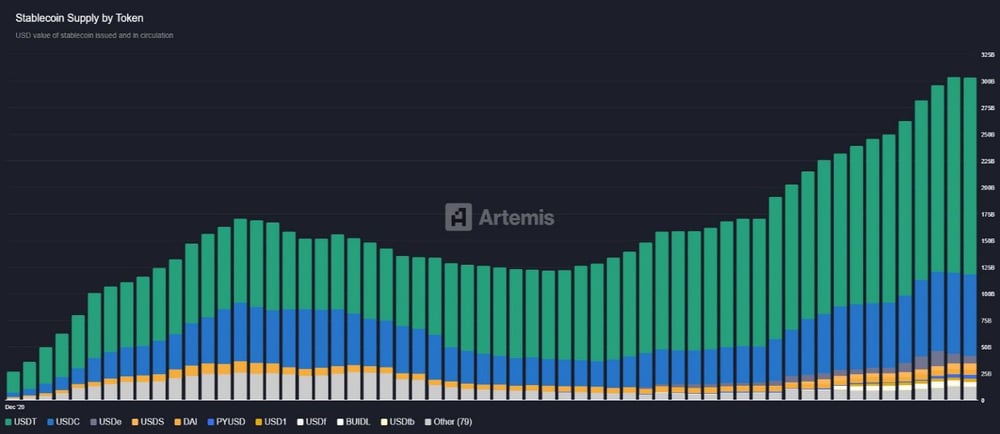
Source: Artemis, as of November 28, 2025
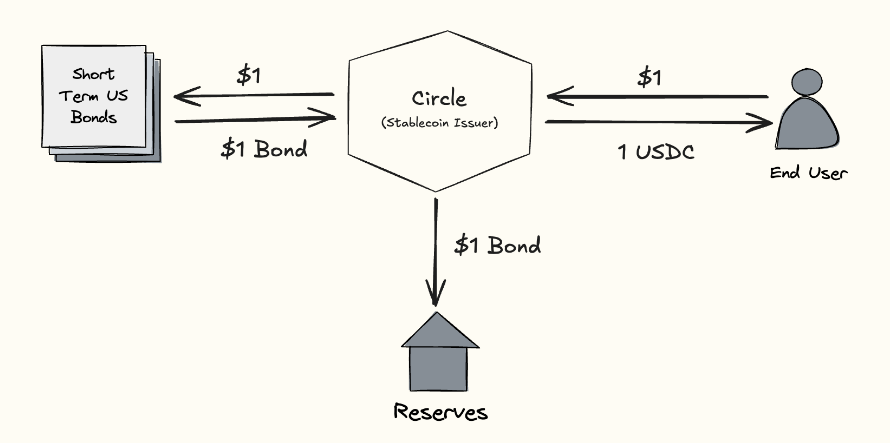
To understand how they work, let’s walk through the life cycle of a single USDC, which is designed to maintain a 1:1 peg with the US dollar.
Source: prannaykedia.com/blog/stablecoin-primer-in-2025
When you purchase USD1 of USDC from its issuer, Circle, a simple but powerful process unfolds. Circle takes your dollar, issues you one USDC token, and simultaneously uses your dollar to buy a highly stable asset, like a short-term US Treasury Bill. This ensures that every single USDC in circulation is backed by a real dollar’s worth of assets in their reserves. When you want to cash out, the process reverses: you return your USDC to Circle, they sell the equivalent reserve asset, and your original dollar is returned to you. This constant, fully-backed minting and redemption process is what keeps the value locked at USD1.
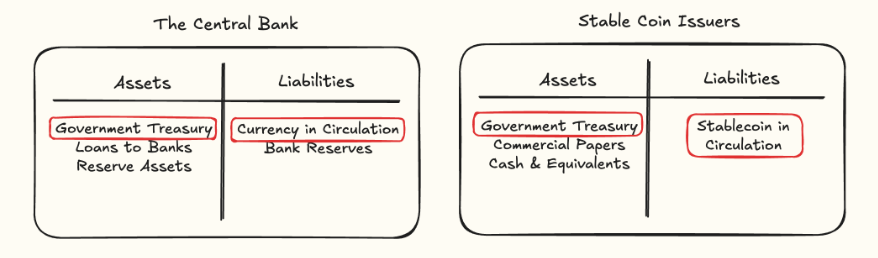
In this sense, stablecoin issuers function much like private central banks. A central bank holds government debt on its asset sheet and issues sovereign currency as its liability. Similarly, issuers like Circle and Tether hold government debt (US Treasuries) as assets and issue their own private currency (stablecoins) as liabilities.
Source: prannaykedia.com/blog/stablecoin-primer-in-2025
Both are creating currency backed by government debt. While both major stablecoins aim for a 1:1 peg, they maintain their reserves in slightly different ways, which is important for transparency and trust.
| Stablecoin (Issuer) | Primary Reserve Assets |
|---|---|
| USDT (Tether) | Diversified reserves including US government bonds, money market funds, collateralized loans, and other cryptocurrencies (e.g., BTC). |
| USDC (Circle) | Focuses exclusively on cash and short-term US government bonds, with regular audits for transparency. |
Ultimately, stablecoins can be thought of as “tokenized dollars” that operate on modern blockchain “rails.” They successfully combine the stability and trust of traditional finance with the speed, low cost, and borderless reach of digital currency.
Having understood how they work, let’s examine why they are becoming so important.
Why Should You Care? The 3 Core Benefits of Stablecoins
Beyond the technical details, stablecoins are gaining traction because they solve real-world financial problems for everyday people and businesses. Here are the three most significant benefits for a beginner to understand.
- Stable and Reliable – Because they are pegged 1:1 to real-world assets, stablecoins don’t experience the wild price swings of other cryptocurrencies. This makes them a reliable digital currency for payments, savings, and transfers, not a speculative investment you hope will increase in value. Their purpose is stability, not volatility.
- Efficient Global Payments – Stablecoins directly address two of the biggest problems in the global financial system: the high cost and slow speed of transferring money. Traditional cross-border bank wires can be painfully slow, taking weeks for large transactions, and incredibly expensive, with fees sometimes eating up to 13.65% of the transfer amount. While stablecoins offer a near-instant alternative, it’s crucial to consider the full end-to-end cost. Converting fiat to stablecoins (“on-ramping”) and back again (“off-ramping”) involves fees that can range from 1% at specialized providers to as high as 7% at crypto ATMs. While often still cheaper, these fees narrow the cost advantage compared to traditional methods.1
- A Hedge Against Instability – For people living in countries with hyperinflation, like Argentina and Venezuela, stablecoins have become a crucial financial lifeline. When a national currency is rapidly losing its value, a dollar-pegged stablecoin provides a secure store of value. In Venezuela, USDT has effectively replaced the local currency for essential transactions like buying groceries and paying rent. In Argentina, the use of crypto is so widespread that some local authorities have even begun accepting tax payments in digital currencies.
These powerful use cases are why stablecoins are gaining attention, but this raises an important question: are they actually safe and legal?
The Three Layers of the Stablecoin Ecosystem
The stablecoin value chain can be understood as three distinct but interconnected layers. Each layer performs a specific job, and all three must work in harmony for the system to function.
Layer 1: Infrastructure – The Digital Rails
The Infrastructure layer provides the fundamental “rails” or digital highways on which all stablecoin activity runs. It is the base layer of technology that makes everything else possible, ensuring that transactions can be processed, secured, and connected across a global network.
| Component | Primary Function (What it does) |
Why It’s Essential (The ‘So What?’) |
|---|---|---|
| Chains & L2s | These are the blockchains (e.g., Ethereum, Tron) where stablecoin transactions are permanently recorded. Layer 2s (L2s) are scaling solutions built on top to lower fees and speed up transactions. | They are the foundational ledger, providing the core ability to transfer value from one person to another securely and transparently. |
| Bridges | Protocols like Wormhole, LayerZero, and Axelar connect different, otherwise separate, blockchains, allowing stablecoins to move from one chain to another. | Bridges create interoperability, transforming isolated blockchains into a unified, global payment network. This is critical for routing payments worldwide. |
| Oracles | Secure data feeds like Chainlink, Pyth, and Band Protocol bring real-world information—like foreign exchange rates—onto the blockchain for use in smart contracts. | Oracles ensure price accuracy for maintaining pegs and for complex operations within the DeFi ecosystem, making them crucial for protocol security. |
With the digital highways in place, the next layer focuses on creating and managing the stablecoins themselves.
Layer 2: Issuance – Creating and Managing Trust
This layer is the financial heart of the stablecoin ecosystem, and its profitability is attracting immense capital. (Tether, for example, generated an estimated ~$535M in revenue per employee in 2024.) The companies here are responsible for minting stablecoins, guaranteeing their value, and ensuring they can be traded. Trust is the most critical product of this layer.
- Stablecoin Issuers – These are the regulated companies, like Circle (USDC) and Tether (USDT), that mint new stablecoins when a user deposits fiat currency and “burn” them upon redemption. They manage the reserves that back the coins and are the foundational trust layer of the entire system.
- Custodians & Attestations – Custodians are the secure, regulated institutions that hold the reserve assets (e.g., US Treasury Bills) backing the stablecoins. They provide regular reports, or “attestations,” that prove the reserves exist and that the stablecoin is fully backed 1-to-1, ensuring transparency and confidence.
- Compliance & KYC – These are the “gatekeepers” that provide infrastructure for Anti-Money Laundering (AML) and Know Your Customer (KYC) checks. Companies like Chainalysis and Elliptic help issuers meet regulatory requirements, which is the “cost of admission for enterprise adoption.” This layer’s importance is magnified by emerging regulatory frameworks like the GENIUS Act in the US and MiCA in the EU, which are legitimizing stablecoins for institutional use.
- Market Makers & Exchanges – These entities provide liquidity, ensuring users can easily trade stablecoins for other assets. Their constant buying and selling is essential to stabilize the peg and increases the adoption of the stablecoin, making it a reliable medium of exchange.
Once these trusted stablecoins are issued and available, the final layer provides the tools for users to access and spend them.
Layer 3: User Interface – The Gateway for Users
This layer is the “storefront” of the stablecoin world. It consists of the applications and services that everyday users and businesses directly interact with to manage, spend, and utilize their digital dollars. The strategic value of this layer is demonstrated by major M&A activity, such as Stripe’s acquisition of Bridge.
- On & Off Ramps – Companies like Ramp and Bridge provide the essential bridges connecting the traditional financial system to the crypto world. On-ramps allow users to convert fiat currency into stablecoins, while off-ramps allow them to convert stablecoins back into fiat.
- Wallets – A digital wallet (like Metamask, Fireblocks, or Coinbase Wallet) is the primary interface for users to store, send, and receive their stablecoins. Wallets act as the “front-door” for users entering the stablecoin ecosystem.
- Decentralized Finance (DeFi) – DeFi platforms like Curve are where stablecoins are put to work. On these platforms, users can engage in advanced financial activities like lending stablecoins to earn interest or using them as collateral to borrow other assets. This is where the capital efficiency kicks in.
Are They Safe and Legal? Regulation & Risks for Beginners
As stablecoins become more mainstream, governments are moving to create clear rules for them, which is a positive development for their long-term legitimacy and safety. In the United States, the landmark GENIUS Act has established a foundational regulatory framework.2
The GENIUS Act introduced several key provisions:
- It officially defines stablecoins as a form of currency, not an investment, clarifying their role in the financial system.
- It allows private companies—both technology firms and traditional banks—to issue stablecoins, provided they operate under clear regulatory oversight.
- It requires issuers to maintain reserves backing their stablecoins on at least a one-to-one basis, consisting only of high-quality assets like US dollars and short-term Treasuries.
- It prohibits stablecoin issuers from offering any form of interest or yield to stablecoin holders.
- It establishes critical consumer protections by ensuring that in the event of an issuer’s bankruptcy, depositors are first in line to get their money back.
While regulation builds confidence, it doesn’t eliminate all risks. It’s important for beginners to understand two primary challenges that remain.
- Risk of a “Digital Bank Run” – If a large number of people try to redeem their stablecoins for dollars all at once (perhaps due to a market panic or a rumor), the issuer could be forced to sell its reserve assets—like government bonds—very quickly. A rapid “fire sale” might force them to sell at a loss, which could cause the stablecoin’s value to temporarily fall below its $1 peg.
- Risk of “Dollarization” – The ease of using dollar-backed stablecoins could lead people in other countries to stop using their own national currency. While this is a benefit for individuals facing hyperinflation, if it happens on a massive scale, it can weaken a nation’s ability to manage its own economy. This echoes the historical example of Argentina’s currency board in the 1990s, which pegged the peso 1:1 to the U.S. dollar. While it initially tamed hyperinflation, it also meant Argentina outsourced its monetary policy, and when economic shocks hit, the country couldn’t devalue its currency, ultimately leading to a catastrophic economic collapse.
Conclusion: A Bridge to the Future
Stablecoins are no longer just a crypto side story; they have the potential to become the financial rails of the internet. By bridging real-world assets with digital systems, they are addressing inefficiencies that have long held back cross-border trade, remittances, and global commerce. As regulation brings legitimacy and adoption scales, the question isn’t if cryptocurrencies will matter, but how they will be integrated.
For founders, investors, and regulators, this is an inflection point. Opportunities are plentiful but implementation comes with unprecedented challenges. No one knows where value will be created, but as one analyst put it, “all we know is that there will be a wave of wealth creation that will leave behind many corpses with some ultra-winners.”
This primer was written by Martin Leinweber, CFA, and Jonas Weber of MarketVector Indexes GmbH (December 2025) and is republished with permission. The views expressed are those of the authors and do not necessarily reflect the views of Amplify ETFs. Investments in cryptocurrencies and digital assets are subject to material and high risk, including the risk of total loss.
1World Bank – Remittance Prices Worldwide (Latest Issue): The definitive source for tracking the costs of traditional cross-border payments globally.
2Latham & Watkins, US Crypto Policy Tracker: Legislative Developments