



Actionable Market Opportunities and Mid-Year Update
The first half of 2025 has unfolded much as we expected—marked by push and pull between persistent uncertainty and remarkable resilience. Inflation has continued its gradual descent, the Federal Reserve has begun to cautiously cut rates, and while geopolitical tensions and tariff threats have added pressure to the global outlook, the U.S. economy has remained on solid footing. In fact, the S&P 500 has surged to new all-time highs, supported by strong corporate earnings and a broadening market rally.
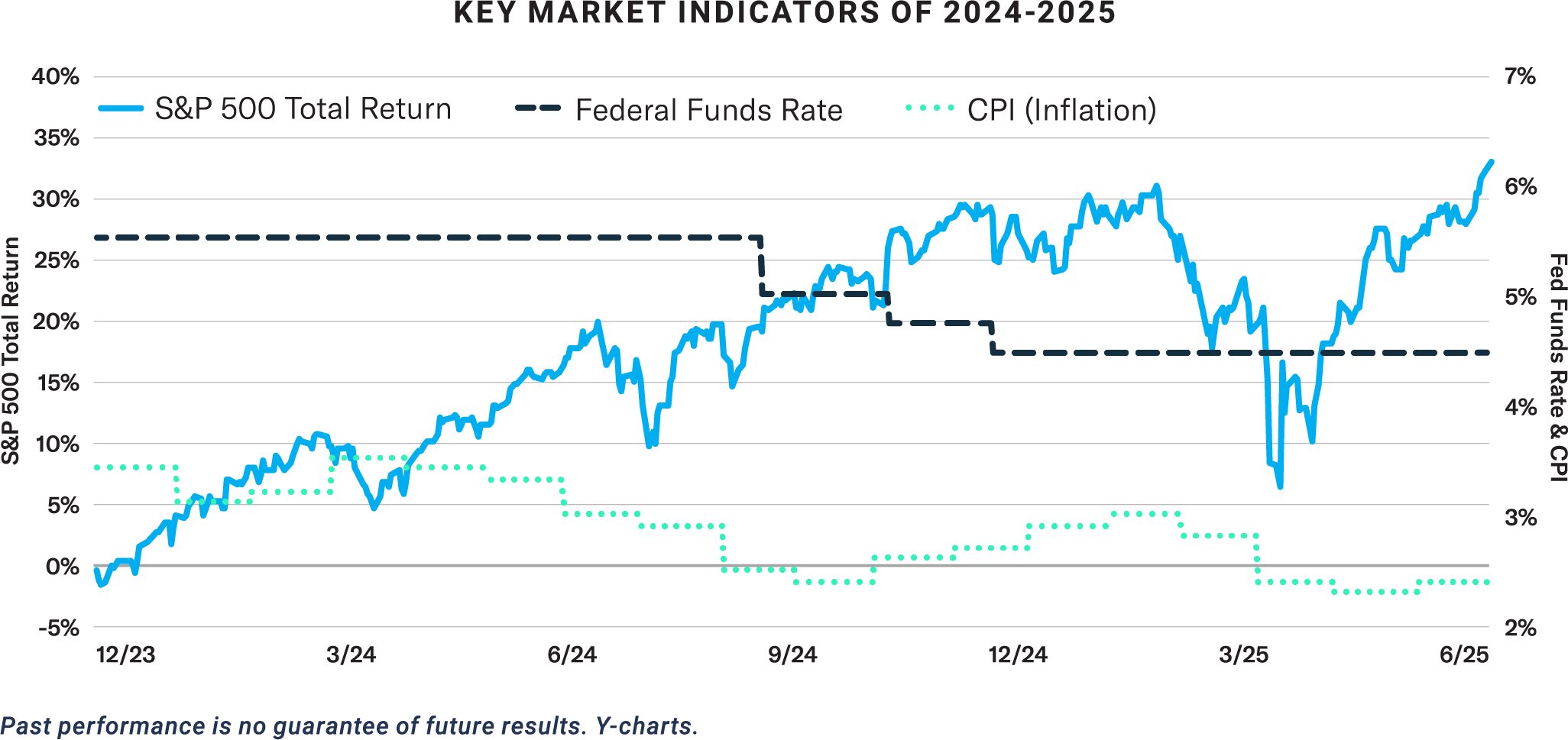
Many of the themes we highlighted at the start of the year have proven prescient: cryptocurrencies and AI continue to reshape the investment landscape, digital thematic trends are gaining traction, and market breadth has improved after years of narrow leadership. Meanwhile, income diversification and volatility management remain essential as investors navigate shifting macro conditions, and the race for scarce resources—from energy to precious metals—continues to shape global dynamics. Against this complex backdrop, here’s our check-in partway through the year.
What we said: Prepare for Volatility
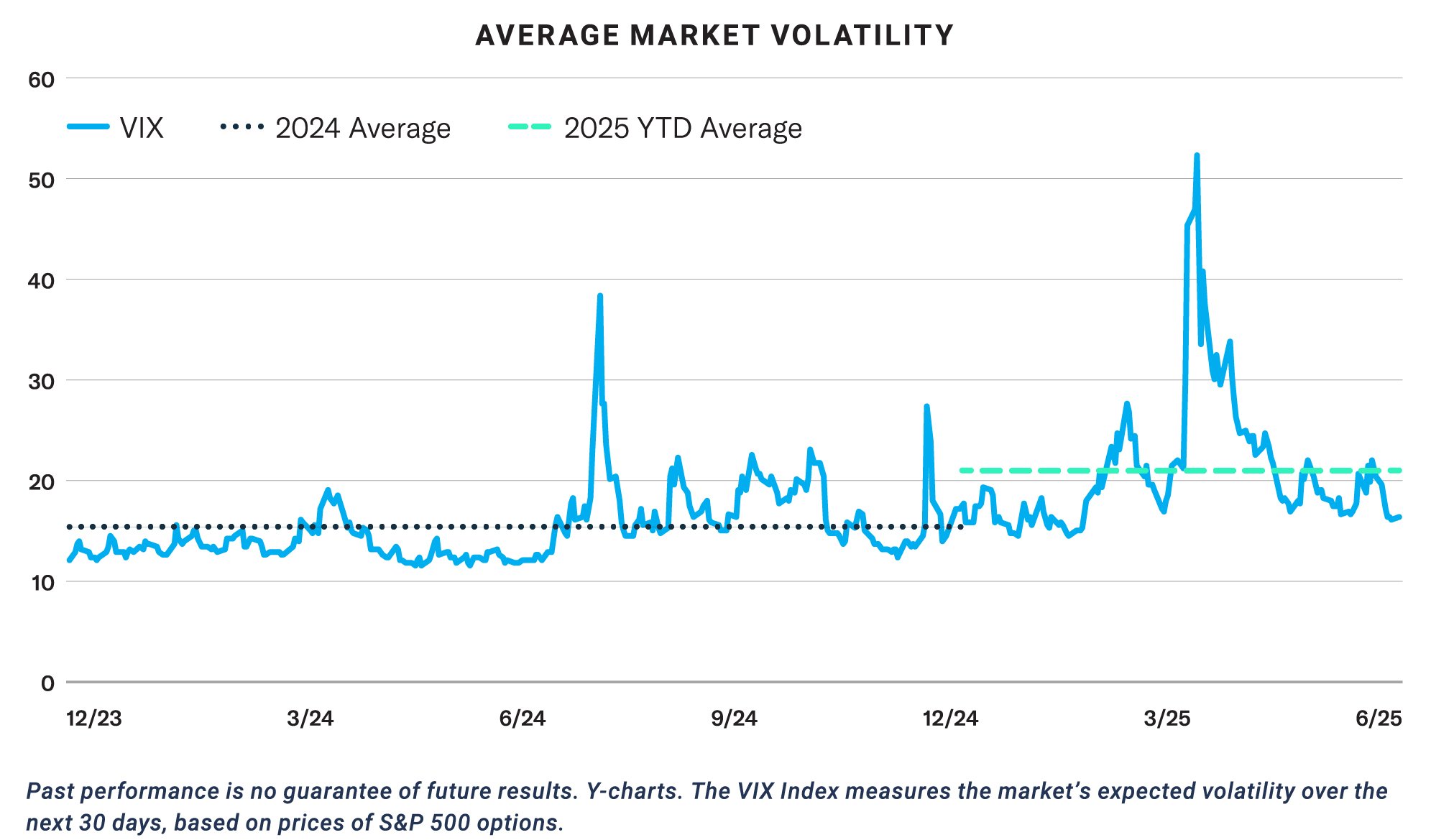
We believed that equity markets would experience periods of heightened volatility driven by economic factors, geopolitical uncertainty and policy announcements.
As we reach the midpoint of 2025, the volatility we anticipated at the start of the year has certainly materialized, with markets experiencing sharp swings driven by shifting tariff headlines, expectations around Federal Reserve policy, uneven economic data, and geopolitical conflict.
In this environment, strategies designed to temper turbulence and generate income have proven especially valuable. ETFs such as DIVO, IDVO, and QDVO have stood out for their focus on high-quality dividend growth and covered call2 overlays, helping to smooth out the roller coaster of equity markets. DIVO has returned 7.78% YTD relative to the S&Ps return of 6.20% at NAV as of 6/30/2025. Likewise, QDVO has returned 8.30% at NAV in the same time period.
(NAV/Closing price as of 6/30/25: DIVO 15.51%/15.35% 1yr, 14.00%/13.94% 5yr, 12.14%/12.13% Since Inception (12/13/2016); QDVO (cumulative) 19.28%/19.35% Since Inception (08/21/24). Expense ratios, DIVO: 0.56%, QDVO: 0.55%.
Meanwhile, the BlackSwan suite (SWAN, ISWN) has offered a compelling black swan hedge through its barbell approach, combining intermediate-duration Treasuries with equity exposure to cushion downside risk while maintaining upside potential.
Notably, YTD ISWN has returned 16.53%, and SWAN has returned 5.69% relative to the S&P 500’s return of 6.20% at NAV as of 6/30/2025.
(NAV/Closing price as of 6/30/25: ISWN 12.24%/12.22% 1yr, -1.98%/-1.99% Since Inception (1/25/21); SWAN 10.78%/11.06% 1yr, 6.21%/6.23% Since Inception (11/05/18). Expense Ratios: ISWN 0.49% , SWAN 0.49%).
What we said: Benefit from Potential Crypto Tailwinds
We believed that a friendly regulatory backdrop, institutional adoption and widening use cases would provide tailwinds to cryptocurrencies along with adjacent companies and industries.
Current Situation: Crypto Momentum Accelerates in 2025
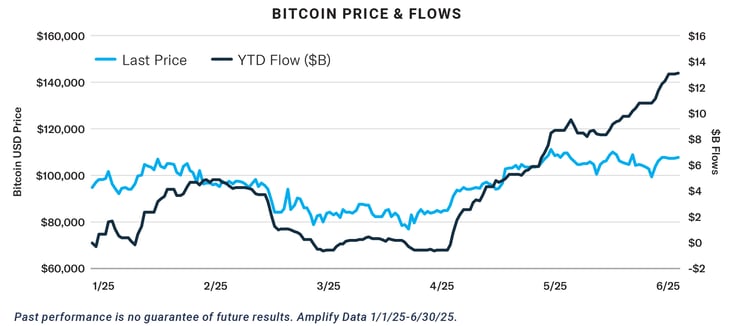
Crypto continues to see strong momentum in 2025 with institutional adoption deepening and investor interest surging. Corporations, particularly Bitcoin treasury companies, have continued to acquire Bitcoin, while spot Bitcoin ETFs* have seen robust inflows. In fact, the fourth largest ETF for inflows in 2025 is a spot Bitcoin ETF. Likewise, Bitcoin’s price has climbed from approximately $94,000 to over $107,000 as of June 30, 2025 and over $119,000 as of July 14, 2025.
We expect Bitcoin adoption by the U.S. federal government and states to increase. Texas, Maine, and Arizona have already passed bills to begin acquiring Bitcoin as part of their investment strategies. Federal legislation is also expected later this year to allow holding and expanding Bitcoin reserves in a revenue-neutral way.
On the regulatory side, the Department of Labor has lifted restrictions on crypto in retirement accounts, signaling a more open stance and the GENIUS Act was just passed by Congress. This legislation will create a federal and state regulatory framework for stablecoins and blockchain infrastructure. This is expected to continue to accelerate institutional and retail adoption of blockchain (which is the technology that underpins cryptocurrencies) and cryptocurrencies such as Bitcoin, Ethereum, and Solana.
Overall, we remain bullish on crypto as both an alpha1 driver and a portfolio diversifier.
Equities in the crypto and blockchain segment have produced attractive returns relative to the S&P 500. Our Amplify Transformational Data Sharing ETF, BLOK, has returned 32.10% YTD at NAV as of 6/30/25. BLOK uses active management to identify and dynamically invest in leading blockchain innovators, crypto infrastructure companies, and digital assets like Bitcoin ETPs.*
(NAV/Closing price as of 6/30/25: BLOK: 70.08%/70.67% 1yr, 28.56%/28.72% 5yr, 19.07%/19.13% Since Inception (1/16/2018). BLOK expense ratio: 0.73%).
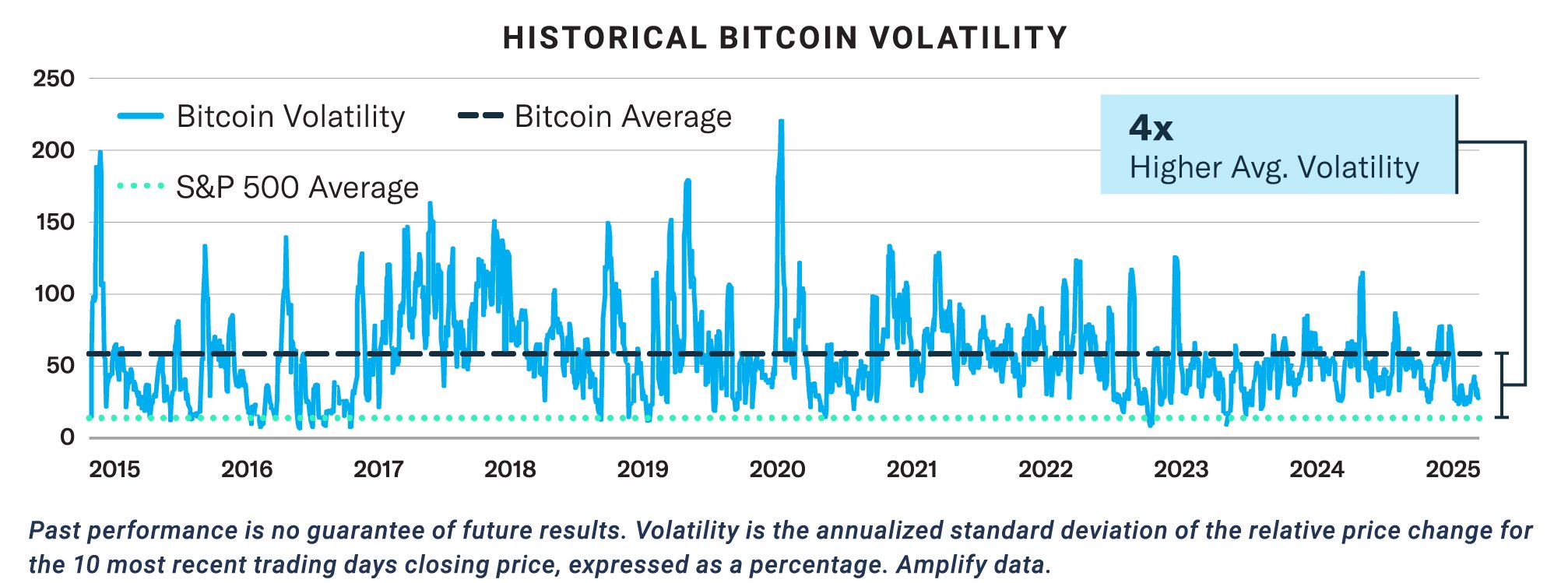
Notably, Bitcoin is historically 4x more volatile than the S&P 500, and investors may have been cautious about adding an allocation to their portfolios as a result.
We previously mentioned how Covered call strategies are recognized for their ability to reduce volatility in equity portfolios—offering a layer of income premium protection during uncertain markets. Now, that same idea is being thoughtfully applied in our Bitcoin covered call strategies to tap into additional income potential while adding targeted digital asset exposure.(BITY, BAGY) This approach combines covered calls as a risk management tool with the evolving opportunity presented by Bitcoin.
Our Bitcoin covered call strategies, BITY, which targets 24% annualized option premium, and BAGY, which seeks 30%-60% annualized option premium, are designed to harvest income and capture various amounts of price appreciation. They have produced attractive returns relative to the S&P with BITY returning 15.85% and BAGY returning 16.54% at NAV since inception as of 6/30/25.
(Cumulative NAV/Closing price as of 6/30/25: BITY 3.90%/3.77% 1m, 15.85%/15.96% Since Inception (4/28/2025); BAGY 4.38%/4.44% 1m, 16.54%/16.91% Since Inception (04/28/2025). Expense Ratios: BAGY 0.65%, BITY 0.65%).
What we said: Focus on Income Diversifiers
Given the limitations of traditional fixed income strategies in a low-interest rate environment, diversifying income streams may be prudent.
Current Situation: Resilient Sources of Income Continue to Look Attractive
In a market where traditional income sources face valuation and rate sensitivity challenges, a diversified approach to income has proven valuable. Our income strategies span a wide spectrum—from actively managed exposure to U.S. equity covered calls and global dividend growers to Bitcoin covered call income strategies and a diversified basket of closed-end funds. Many of our income offerings present opportunities to generate current income while balancing the potential for capital appreciation.
Together, they offer attractive income potential with the added benefit of downside mitigation through income generation:
- Enhanced Equity Income: Covered call strategies like DIVO, IDVO, QDVO and HCOW generate current income from covered call premiums and equity dividends with diverse equity market exposure.
- Access Global Dividend Growth: Global equities have shown strength against U.S. equities in 2025 and IDVO offers exposure to international and quality-focused dividend paying equities.
- Tap Into Digital Premium Income: Bitcoin income strategies such as BITY (targets 24% annualized option premium) and BAGY (seeks 30%-60% annualized option premium) offer high income from an asset class that historically has little correlation to equities and fixed income.
- Utilize Closed-End Funds (CEFs): YYY provides access to high-distribution, actively managed CEF strategies across a diverse spectrum of asset classes.
- Explore High-Income Free Cash Flow (FCF) Strategies: HCOW utilizes covered calls on companies with strong backward and forward looking FCF to generate high income and provide capital appreciation potential.
- Diversify Among Fixed-Income: TLTP targets 12% annualized option premium through a covered call strategy on treasury based holdings, while SOFR delivers monthly income without extending duration risk as it’s based on the Secured Overnight Financing rate.
In short, today’s unique strategies offer a broader toolkit than ever before for generating yield with a built-in cushion against volatility.
What we said: Position for the Return of Market Breadth
We suggested that after several years of market leadership from top mega cap tech names, it would be prudent to position for returns to be driven by a broader group of companies.
Current Situation: Equity Market Breadth Made a Notable Comeback in 2025

Performance is no longer concentrated in just a handful of mega-cap tech names. International equities are leading U.S. equities year-to-date, and a wider range of sectors are contributing meaningfully to returns, rewarding investors who have maintained a diversified portfolio. Specifically, International stocks have taken significant strides, IDVO, our actively managed international equity covered call and income ETF, has returned 18.78% YTD, at NAV as of 6/30/25. Likewise, ISWN has similarly impressive performance of 16.53% YTD NAV as of 6/30/25.
(NAV/Closing price as of 6/30/25: IDVO 20.10%/20.05% 1yr, 18.91%/18.93% Since Inception (9/07/22); ISWN 12.24%/12.22% 1yr, -1.98%/ -1.99% Since Inception (1/25/21). Expense ratios: IDVO 0.66%, ISWN 0.49%).
SMID (small and mid) cap has lagged as interest rates have remained higher for longer than expected and credit conditions remain somewhat tight. Smaller companies are more sensitive to borrowing costs but rate-cut expectations are favorable in the second half of 2025 and we remain optimistic that breadth will continue to expand to include smaller and mid cap companies.
What we said: Focus on Long-Term AI and Thematic Investments
We believe that opportunities in AI and other key themes present opportunities for investors to access diversified growth in the equity markets.
Current Situation: Digital Innovation Continues to be a Powerful Engine of Growth in 2025
Several thematic areas have outperformed the broader market. Year to date, sectors like artificial intelligence (AIVC YTD 9.71%), cybersecurity (HACK YTD 15.91%), and video gaming (GAMR YTD 28.21%) have delivered strong alpha relative to the S&P 500, driven by surging enterprise adoption, rising consumer engagement, and ongoing investment in digital infrastructure (NAV as of 6/30/25).
Digital payments (IPAY) have also seen a boost, fueled by the continued shift toward cashless transactions and the growing relevance of digital payment platforms in the evolving financial ecosystem. Meanwhile, online retail (IBUY) may be poised for a seasonal tailwind, as the second half of the year has historically brought strength tied to holiday shopping and e-commerce promotions.
Cybersecurity remains a high-conviction theme, fueled by strong and sustained tailwinds into a large, untapped market valued at $1.5-2 trillion. 3 Remarkably, the current market penetration is estimated at only 10%.3 With cyber breaches making headlines almost weekly, the urgency for robust digital defense solutions continues to climb. The essential, utility-like nature of cybersecurity services has made them a non-discretionary line item for both corporations and governments in an increasingly digital world.
We believe, as digital transformation accelerates across industries, these themes remain compelling opportunities for growth.
(NAV/Closing price as of 6/30/25: AIVC 17.86%/17.82% 1yr, 8.98%/8.96% Since Inception (03/07/16); HACK 33.41%/33.57% 1yr, 14.40%/14.40% 5yr, 12.81%/12.82% Since Inception (11/10/14); GAMR 38.91%/38.79% 1yr,
9.09%/9.12% 5yr, 15.19%/15.22% Since Inception (03/07/2016); IPAY 28.82%/29.06% 1yr, 9.41%/9.40% Since Inception (07/14/15). Expense ratios: AIVC 0.59%, HACK 0.60%, GAMR 0.59, IPAY 0.75%).
What we said: Recognize the Implications of Resource Demand and Scarcity
Precious metals like silver and natural resource stocks like those in the Energy and Material sectors could benefit for a variety of reasons such as industrial demand growth and a potential weakening U.S. dollar.
Current Situation: Resource Constraints are Gaining Traction
Geopolitical risks have escalated, particularly related to a possible closure of the Strait of Hormuz, which transfers approximately ¼ of the world’s oil supply. However, the U.S. has grown more energy independent and is now the largest exporter of Liquid Natural Gas and a net exporter of crude oil.
Amid rapid expansion, the U.S. natural resource stocks from Energy and Materials sectors (NDIV) as well as natural gas equities (USNG) may present an attractive long-term investment opportunity, fueled by strong U.S. policy support, rising energy demand from data centers and AI, and cost advantages over other energy sources.
Silver has seen tremendous traction and growth this year, with returns of 23.70% and SILJ returning 48.29% YTD at NAV as of 6/30/25.
(NAV/Closing price as of 6/30/25: SILJ 39.52%/40.23% 1yr, 8.98%/ 9.03% 10yr, inception date 11/27/12). Expense ratio: SILJ 0.69%.
2025 is expected to be the fifth consecutive year of supply shortfall due to booming industrial demand and its status safe haven asset. Silver’s demand is expected to outpace supply by 149 million ounces in 2025.4 Constrained supply, coupled with rising demand has created an imbalance and set the stage for significant price growth potential.
Additionally, the gold to silver ratio is hovering around 91, however the historical long-term average is 50-60.5 A normalization of the gold to silver ratio may also provide an additional tailwind to the price of silver in the second half of the year. Silver miners may offer leveraged exposure to this asset class.
Conclusion
The great athlete, Michael Jordan, once said, "Obstacles don't have to stop you. If you run into a wall, don't turn around and give up. Figure out how to climb it, go through it, or work around it." The first half of 2025 has brought its share of walls—geopolitical tensions, shifting market conditions, and bouts of volatility—but it has also provided opportunities to adapt and thrive. From resilience in the U.S. economy to groundbreaking innovation in digital assets and income strategies, this year has rewarded those willing to embrace uncertainty and think creatively about the obstacles on the horizon. As we look ahead, we believe the right mix of diversification, strategic positioning, and adaptability will continue to unlock opportunities in this dynamic market environment.
Related ETFs
Volatility Focused
Crypto Focused
Income Diversifiers Focused
Market Breadth Focused
Digital Breadth Focused
Resource Demand Focused
1 Alpha is a measure of an investment's performance relative to a benchmark index, such as the S&P 500.
2 A covered call refers to a financial transaction in which the investor selling call options owns an equivalent amount of the underlying security.
3 Nasdaq Research
4 Global Silver Market Forecast to Remain in a Sizeable Deficit in 2025. | The Silver Institute 5 Y-Charts
Indexes are unmanaged and it’s not possible to invest directly in an index. The S&P 500 Total Return Index is I’m a market-capitalization-weighted index of the 500 largest U.S. publicly traded companies The S&P Small Cap 600 Index seeks to measure the small-cap segment of the U.S. equity market. The S&P 400 Index is a stock market index that tracks the performance of 400 mid-sized U.S. companies. The EAFE Index tracks the performance of large- and mid-cap companies in 21 developed countries.
*Bitcoin ETPs (Exchange traded products) are exchange-traded investment products not registered under the 1940 Act that seek to generally match the performance of the price of Bitcoin, and trade intraday on a national securities exchange. BAGY & BITY do not invest directly in Bitcoin.
Covered call risk is the risk that the Fund will forgo, during the option’s life, the opportunity to profit from increases in the market value of the security covering the call option above the sum of the premium and the strike price of the call, but has retained the risk of loss should the price of the underlying security decline.
Investments concentrated in specific industries, sectors, markets, or asset classes may underperform or experience greater volatility than the general securities market. Investments in small and mid-cap companies may have limited liquidity and greater price volatility than large-capitalization companies. Investments in AI, cloud technology, blockchain, or cybersecurity companies are exposed to risks such as small markets, technological obsolescence, and government regulation. These companies, especially smaller ones, are more volatile and susceptible to adverse events in specific regions or industries.
BAGY: The annualized option premium may be significantly higher or lower than the stated range. Beyond the first 5% increase each week the Fund would not participate in the upside. BITY: There is no guarantee the Fund will achieve the Target Option Premium in any given year. If the NAV of the Fund remains level or decreases during any one-year period, the annualized premium generated by the Fund may be significantly less than the Target Option Premium for that time period.
The Funds face risks by investing in Bitcoin through the Bitcoin ETP and Bitcoin ETP Options, as Bitcoin is a new and highly speculative investment with various risks.
Trading in shares of a Bitcoin ETP on U.S. securities exchanges may be halted. Option contract prices are volatile and affected by changes in the underlying asset’s value, interest or currency rates, and expected volatility, all of which are influenced by political, fiscal, and monetary policies.