



First Quarter 2026 Commentary
Performance Overview
In the first quarter of 2026, BLOK declined 12.68% total return (NAV, view standardized performance). This performance stands in contrast to continued progress in blockchain adoption and recent policy discussions related to digital asset market structure, including proposed legislation such as the Clarity Act. Bottom line: Near‑term performance remains dependent on market sentiment and broader developments.
Despite near-term price weakness, underlying adoption trends remain strong in our opinion. According to Artemis Research, reported stablecoin transaction volume reached approximately $7.2 trillion in February, surpassing the $6.8 trillion processed by the Automated Clearing House (ACH) network. This reflects a meaningful milestone, as ACH underpins approximately 93% of U.S. salary payments and digital wallets touch half the global population, according to Larry Fink.i It may be that Jamie Dimon is less focused on stablecoin yield and more concerned about the long-term role of banks serving middle-income America. Payments in and payments out serve as the core platform and use case for a direct connection to the customer. Gen Z is accelerating the shift from mobile to phone-based checkout with usage in the range of 39-41% of the time. Globally, the value of payment app transactions climbed to $10.6 trillion last year from $9.3 trillion in 2024, with a forecast projecting growth to approximately $15.6 trillion by 2030. ii
Transaction volume in stablecoin continued to increase in March, reaching $7.5 trillion, compared to an estimated $1.2 trillion for the Visa network. These figures highlight the increasing scale of blockchain-based payment systems, which operate 24 hours a day, 365 days a year, with significantly lower friction than traditional infrastructure in our opinion.
The performance data quoted represents past performance and does not guarantee future results. Investment return and principal value of an investment will fluctuate so that an investor’s shares, when sold or redeemed, may be worth more or less than their original cost. Current performance may be lower or higher than the performance quoted. For most recent month-end performance, visit BLOKETF.com.
Adoption vs. Market Performance
While stablecoin transaction volume growth is substantial—totaling approximately $35 trillion in 2025—it still represents a small fraction of the $1.6 quadrillion global payments ecosystem. Additionally, much of this activity remains tied to crypto trading rather than everyday consumer payments. However, this level of usage provides insights into the functionality and scalability of the underlying technology.
Further evidence of adoption can be seen in the growth of wrapped assets, which now total approximately $315 billion in assets under management. Forecasts suggest this could reach $2 trillion by 2028 (Standard Chartered) and potentially $3 trillion by 2030.iii
Stablecoin Market Insights
While transaction volume demonstrates that stablecoin technology functions and sees real-world use, a closer examination of the data reveals a more nuanced picture. A McKinsey reportiii provides additional context that shows we are still in early stages. Most of the ~$35 trillion in transaction activity does not represent true end-user payments such as paying suppliers or sending remittances — it consists primarily of trading, internal fund transfers, and automated blockchain activity.
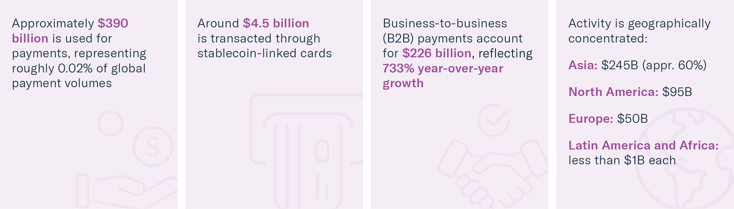
This data suggests that while traditional financial systems are not yet losing meaningful market share, stablecoins are being explored and utilized as an emerging tool for certain payment and settlement use cases.
Implications for the Financial System
Stablecoins offer several structural advantages:
 |
Real time 24/7 settlement |
 |
Lower transactions and foreign exchange costs |
 |
Improved capital efficiency |
 |
Seamless cross-border transfers |
Even modest efficiency gains can have significant economic impact. For example, a 0.1% improvement on $1 trillion equates to $1 billion in value creation for the broader economy. Applied to the broader $1.6 quadrillion payments landscape, the potential efficiency gains are substantial. Bottom line, decentralized finance (DeFi) focuses on reducing frictional costs in the system. Arguably the question is who gets the 3% payments value? Banks and credit card companies? Walmart for servicing their own customers? The consumer with a trackable digital wallet that is willing to spend money on specific types of purchases in exchange for rebates/rewards?
As a result, incumbents—including banks, payment networks, and financial intermediaries—are increasingly incentivized to adopt and integrate this technology rather than compete against it.
Evidence & Regulatory “Clarity” Could Make Real World Assets (RWA) an Exciting Opportunity
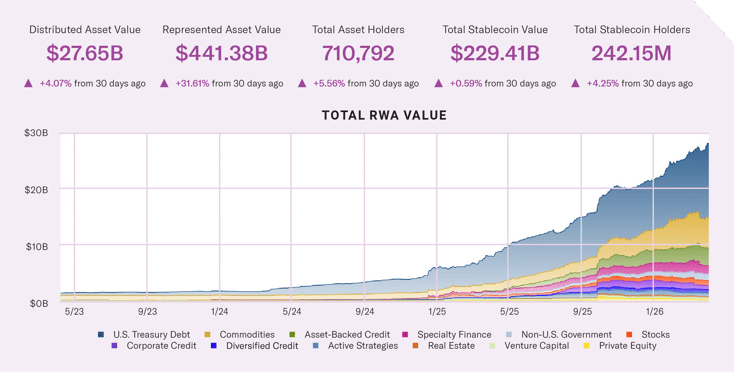
Beyond payments, the tokenization of real-world assets continues to gain traction. According to the RWA.XYZ Global Market Review, the total RWA market size reached $27.65 billion as of March 31, 2026, with representing: Asset Value of $441.38B, Total Asset Holders of 710,792, Total Stablecoin Value of $229.41B, and Total Stablecoin Holders of 242.15M.
 |
4% growth month-over-month |
 |
Approximately fourfold growth from $6.6B one year ago. |
 |
Total holders of approximately 710,792, up 5% month-over-month |
 |
Dollar value of $29B, up 8% from 30 days ago at the time of this writing (Check it out – changes daily.) |
When thinking about the synergies between blockchain and artificial intelligence (AI), investors often describe AI as the brains and blockchain as the nervous system. We think this narrative speaks a lot to how “trust” is earned and validated within the blockchain structure. While in many ways stablecoins, as a leading blockchain application, may in the long term replace the current trillion dollars in payment rails, we see consumer lending, including Home Equity Line of Credit (HELOCs) and auto loans, as another substantial use case for RWA. Arguably, some industry estimates suggest this could represent the next $300 billion application, reflecting potential disruption across these two lending markets. RWA may also encompass the tokenization of securities and investments, an application that could add trillions of dollars in assets under management over time.
Portfolio Attribution
BLOK declined 12.68% NAV in the first quarter, including a 7.07% NAV decline in March. While Bitcoin is not our benchmark, the portfolio has historically shown correlation to its price movements. Bitcoin declined approximately 22% during the same period.
Short-term market dislocations may influence long-term attractive investment opportunities. Our portfolio construction emphasizes diversification across key segments of the blockchain ecosystem, including:
 |
Platform companies (30.62%) |
 |
Indirect exposure to Bitcoin and Ethereum (12.47%) |
 |
Data centers (19.62%) |
We view data center investments as long-duration, supply-constrained assets that benefit from both AI and blockchain demand dynamics.
|
Transaction and Repositioning: During March, we made moderate adjustments to the portfolio:
We have been tracking Broadridge’s use of permissioned blockchain, as a platform, for years and in fact, as a firm, we are users. Readers will find the firm’s use of blockchain interesting in that it has little to do with crypto price action and more to do with efficiency and the use of blockchain as a distributed ledger. It’s about automating the multiple intermediaries, manual reconciliation, and T+1 or 1+2 delays. First, on average the company moves about $354 billion in daily repos with volumes totaling $8 - $9 trillion. The daily average is a 392% increase year-over-year. As a solution, Broadridge’s latest whitepaper with Finadium found that the intraday Digital Ledger Repo (DLR) can improve the balance sheet efficiency for participants by reducing the need for external funding or redeploying capital for other business uses. This analysis uncovered that a 15% use of intraday DLR could reduce intraday liquidity buffer needs by 8-17%. Here’s a summary of how the Broadridge Digital Ledger Repo (DLR) service operates, according to Finterra:
Second, with Galaxy Digital (GLXY) as the first client, they are expanding their corporate governance platform by automating proxy voting of tokenized securities.iv We think this is an important step forward beyond just the chatter around the excitement for 24/7 tokenized securities. We are pleased to see two pioneers in our portfolio working together to demonstrate blockchain technology benefits. While BR is new to the portfolio, we were very early investors in Galaxy, dating back to 2020. |
i Blackrock. Larry Fink’s 2026 Annual Chairman’s Letter to Investors. March 2026.
ii Payment Week Fintech. Us digital wallet use projected to grow by 2030. April 6, 2026.
iii McKinsey & Company. Stablecoins in payments: What the raw transaction numbers miss. February 18, 2026.
iv Broadridge. Live with On-Chain Governance for Tokenized Equities, Extending Market Infrastructure into Digital Assets. April 6, 2026.