



After 100 Months, We Have "Clarity"
April marked a significant rebound for the Fund, with a gain of 19.47% that brought year-to-date performance to 4.33% total return (NAV; see standardized performance). Since launching in January 2018 as the first blockchain-focused fund, we have built a 100-month record of actively managing risk in this category. Volatility remains a defining feature of this emerging asset class, driven by shifting expectations around the timing and pace of technological adoption, but investors have been rewarded with an 17.69% annualized return since inception as of 4/30/2026. The Fund has also maintained consistently low overlap with the S&P 500 and Nasdaq, at levels below approximately 8% by weight.1 In our view, experience in this market matters, and we are proud of the track record we’ve established.
As we look to the balance of 2026 and beyond, the recent recovery rally was not unexpected.
The performance data quoted represents past performance and does not guarantee future results. Investment return and principal value of an investment will fluctuate so that an investor’s shares, when sold or redeemed, may be worth more or less than their original cost. Current performance may be lower or higher than the performance quoted. For most recent month-end performance, visit BLOKETF.com.
Despite investor concern around the timing of the CLARITY Act and broader market sentiment, blockchain adoption has continued to advance steadily. As financial infrastructure increasingly integrates blockchain-based payment rails, we expect efficiency, transparency, and faster settlement may help support adoption across a growing range of industries.
Although much of the recent rebound was driven by the Fund’s data center and miner exposure, we believe the move may have further room to run. As of May 1st, a bipartisan compromise on stablecoin yield had advanced toward Senate Banking Committee markup, an important signal that U.S. digital asset policy may be moving toward a more workable framework.
The specific terms of the compromise are straightforward:
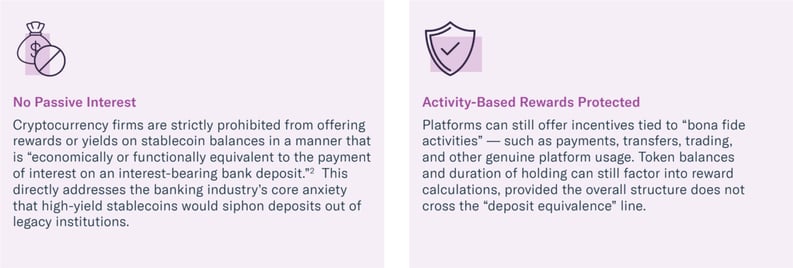
In practical terms, the era of simple “buy-and-hold” yield on stablecoins appears to be ending. To comply with the proposed framework, crypto firms would need to shift toward a “buy-and-use” model that ties rewards to genuine platform activity rather than passive balances.
Why This All Matters: CLARITY
The CLARITY Act matters not only because it addresses a jurisdictional divide between regulators, but also because it could establish a durable framework for how digital assets are classified under U.S. law. Its significance lies in the recognition that the same token may begin as a security and later function as a commodity, that regulatory treatment depends on the nature of the transaction rather than the token alone, and that spot markets for crypto commodities require a formal regulatory structure rather than operating in a legal gray zone. In our view, that shift would move the industry away from enforcement-led uncertainty and toward a more predictable operating environment for institutions, exchanges, and developers.
We also believe this framework could accelerate adoption of tokenized real-world assets, a category that has continued to expand rapidly.
At its core, CLARITY seeks to define whether digital assets should be treated as securities or commodities under U.S. law, which in turn determines whether the Securities Exchange Commission (SEC) or the Commodity Futures Trading Commission (CFTC) has primary regulatory authority over a given activity. Put simply, assets classified as securities fall under SEC jurisdiction.
The summary below outlines the major categories. In broad terms, only digital securities issued as investment contracts—such as tokenized stocks or bonds—would remain under SEC oversight, while most other categories would fall primarily under the CFTC.
 |
Digital Commodities A crypto asset that is linked to and derives value from the operation of a crypto system, rather than the expectation of profits. The guidance specifically mentions Bitcoin (BTC), Ethereum (ETH), Solana (SOL), and fifteen other cryptocurrencies. Digital commodities are not treated as securities. |
 |
Digital Collectibles Crypto assets that are designed to be collected, and may represent or convey rights to artwork, music, videos, trading cards, in-game items, memes, characters, or cultural content. NFTs and memecoins may fall under this category. Digital collectibles are not treated as securities. |
 |
Digital Tools Crypto assets that perform a practical function, like representing proof of a membership, ticket, credential, and other similar use cases. Digital tools are not treated as securities. |
 |
Stablecoins Crypto assets designed to maintain a stable value equivalent to its pegged asset. Payment stablecoins under the GENIUS Act are not securities. |

|
Digital Securities Digital assets issued as investment contracts with promises of future profits. Includes tokenized securities (i.e., traditional financial instruments that are traded on a blockchain, including tokenized stocks and bonds). Unsurprisingly, digital securities are treated as securities. |
Operationally, the SEC and CFTC have signaled a greater willingness to work together, but congressional action would be constructive because it would define jurisdiction on a bipartisan statutory basis. By contrast, the prior enforcement-led approach created uncertainty that, in our view, discouraged innovation and adoption. For many market participants, a clearer legal framework would represent a meaningful reset for crypto and for the broader tokenization opportunity developing across blockchain networks.
AI & Blockchain Synergies:
Blockchain can provide transparency, provenance, and decentralized settlement infrastructure that AI systems need to improve trust, accountability, and interoperability. Conversely, AI can provide the decision-making and coordination capabilities required to manage increasingly complex multi-chain ecosystems. As AI agents gain the ability to operate wallets and execute tasks autonomously, they may become important users of blockchain-based financial networks.
In short, crypto can give AI agents economic agency, while AI can give crypto systems the intelligence to operate at greater scale and with less human intervention.
One of the key unresolved questions is how an AI agent can be trusted in a first-time interaction. Blockchain-based identity, reputation, and validation systems offer a potential answer.
ERC-8004 is an Ethereum Improvement Proposal focused on trustless agents. The draft was created on August 13, 2025, by contributors from MetaMask, the Ethereum Foundation, Google, and Coinbase, and it outlines lightweight on-chain registries for identity, reputation, and validation that could help AI agents discover one another and establish trust across platforms. ERC-8004 has also been reported as having registry deployments on Ethereum mainnet in January 2026, although the proposal itself remains labeled as a draft standard.
Progress Strategic Bitcoin Reserve (SBR)
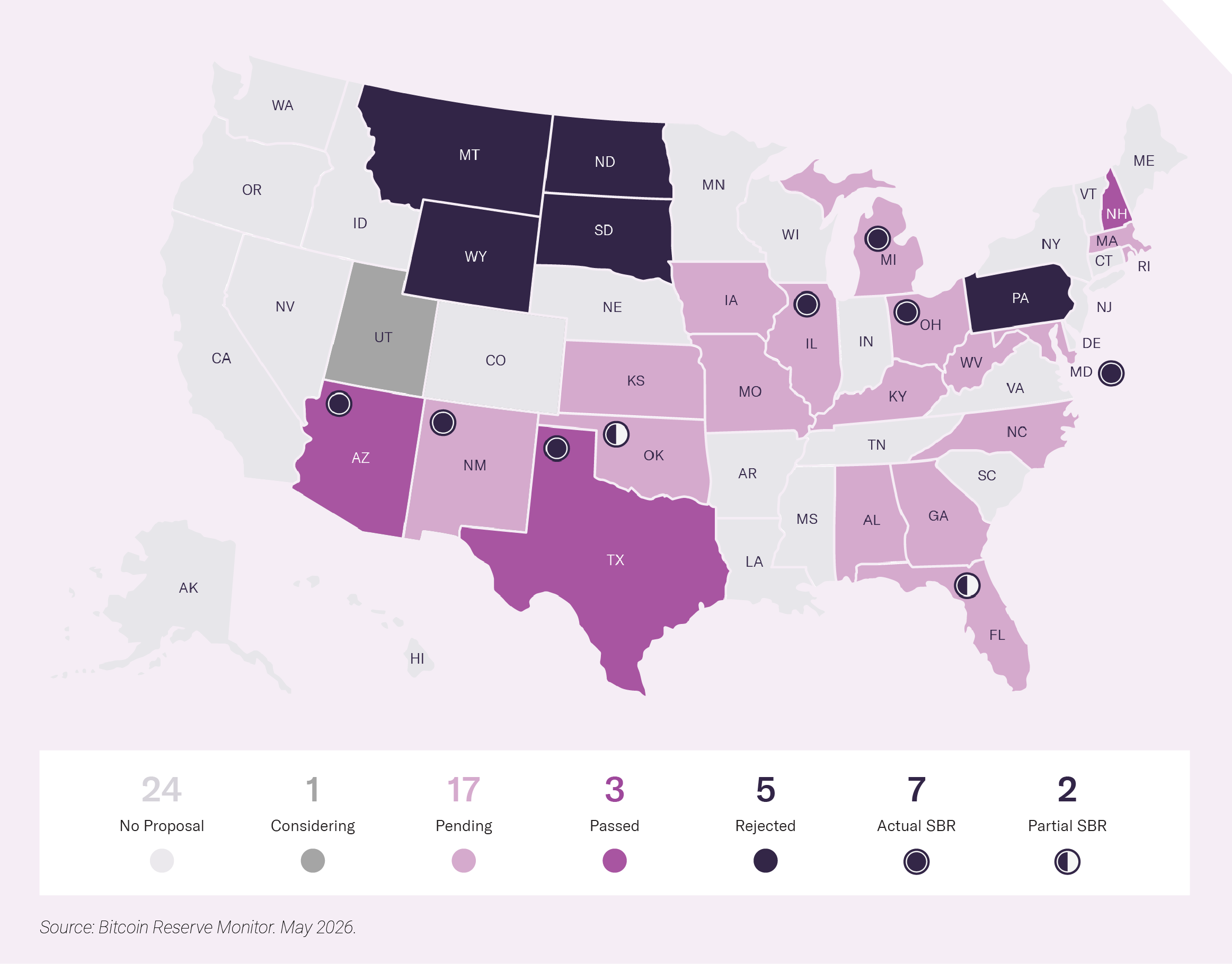
We are not Bitcoin maximalists, but the Fund maintains strategic indirect exposure to Bitcoin and other digital assets, with Bitcoin and Ethereum exposure representing roughly 7 to 12% of the portfolio weight. This weighting includes spot exchange traded products (ETPs) at about 7-8% and three Digital Asset Treasury (DATs) companies. Given the momentum around the CLARITY Act, we believe some policymakers may become more willing to discuss the concept of a Strategic Bitcoin Reserve. For that reason, we suggest monitoring this theme using the map shown below.
Attribution:
BLOK’s rebound of 19.47% was broad with only a few companies providing headwinds. We believe that the synergies between blockchain and Agentic AI make the datacenters a rational over-weighted infrastructure position. To this point, in April big moves came from HUT8 (HUT/+61%), Terawulf (WULF/+50%), Galaxy Digital (GLXY/+48%), Cipher Digital (CIFR/+37%) Applied Digital (APLD/ +44%) and Core Scientific (CORZ/+33%). These positions remain top positions and were weighted at about 3 to 4.5% during the month.
Bitcoin rose about 12.75% during the month but remained down about 12.7% YTD. The Fund will at times outperform Bitcoin and at times underperform it, but Bitcoin should not be viewed as the Fund’s benchmark. We include the comparison because it remains a common reference point for investors.
|
Transaction and Repositioning: During the month, we exited Roblox (RBLX) following a disappointing quarter, though its modest position at 1.6% limited overall impact. |
1 Overlap by weight refers to the percentage of shared portfolio exposure based on each holding’s allocation.