



The Genius Behind Blockchain & Global Payments
Performance Highlights
BLOK delivered a strong first half of 2025, up 32.10% year-to-date, with a remarkable 54.04% gain in Q2 and 17.87% in June alone (NAV returns, view standardized performance). Throughout this period of heightened volatility, we remained confident in our core positioning, making only modest adjustments (see Cooler Heads Will Prevail). This consistency reflects our long-standing investment discipline—built over the past eight years—and our conviction in the secular growth trends driving Blockchain adoption.
As part of our process, we trim positions exceeding 5.5–6% and reallocate capital in 50–100 basis points (BPs)* increments toward asymmetric opportunities. This disciplined approach helps us compound growth from winners while containing risk when the thesis changes or falters. For smaller-cap companies, especially those under $5 billion, we maintain close contact with management teams to understand the execution path and risk environment. Over the course of the recent 12 months, we believe we have added about 100 new companies to our proprietary database.
Blockchain Adoption Reaches a Tipping Point
Never in BLOK’s history have we seen such robust signals for Blockchain adoption—regulatory momentum, capital inflows, and real-world integration are converging. A focal point of our strategy is exposure to the $1.8 quadrillion global payments market, where we believe Blockchain can be as disruptive as ETFs were to traditional asset management—only on a massively larger scale.
According to McKinsey, the global payments industry processed 3.4 trillion transactions and generated $2.4 trillion in revenues from 2018–2023, growing at 7% annually.1 The sector is expected to grow to $3.1 trillion, with significant margin compression. Blockchain is positioned to streamline this massive ecosystem, particularly when paired with AI to increase trust, automate workflows, and securely transfer value.
As an example, Stablecoins, powered primarily through Ethereum, Solana, and Layer 2 protocols, are emerging as a trusted digital vehicle for dollar-denominated value transfer. If Bitcoin—decentralized and validated through cryptography—can be trusted by over 100 million people globally as an alternative store of value, then cryptographic coding has the potential to revolutionize industries far beyond finance.
Key Adoption Catalysts in Focus
- Bitcoin Momentum and Institutional Uptake
As of June 30, Bitcoin is up ~15% YTD. With the recent passage of the “One Big Beautiful Bill” injecting an additional $5 trillion into the economy, Bitcoin’s case as a hedge is reinforced.
261 companies now hold Bitcoin in their treasuries, up from 225 last month, including top BLOK holdings MicroStrategy (MSTR) and Metaplanet (3350 JP/MTPLF). We increased exposure to MSTR in June and now maintain roughly a 17% combined exposure across treasury companies (10%) and Spot Bitcoin ETFs (7.5%).
Texas became the third state to adopt a Bitcoin reserve law, joining New Hampshire and Arizona—but it’s the first to allocate public funds for Bitcoin reserves.
According to the River platform, America is now leading in Bitcoin, but we think it is not just in Bitcoin. As we have written in the past, we believe that funding for Blockchain projects through venture capital is accelerating and we would not be surprised to see new highs in project financing in 2025. Funding for Bitcoin treasury companies in the form of SPACs (Special Purpose Acquisition Company) and U.S. listings has increased where hundreds and sometimes billions of dollars are being raised and not just for Bitcoin.2 Ethereum and Solana have also drawn new launches. See chart below about Bitcoin dominance in America and research source in the educational section for additional resources.3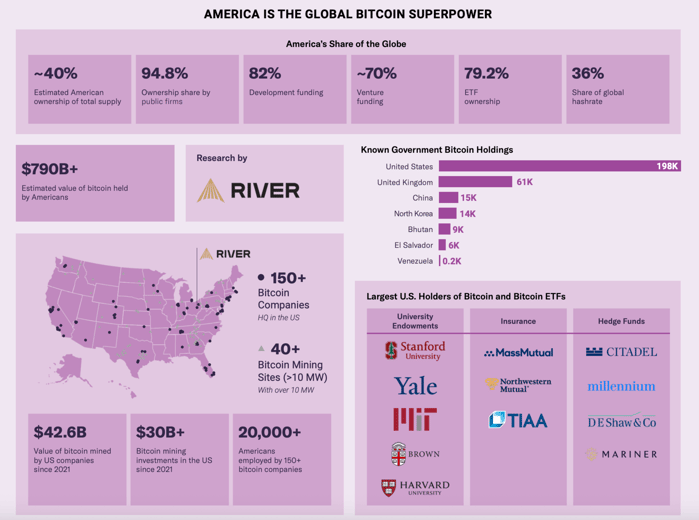 Source: River Research, The American Bitcoin Advantage, May 2025.
 - Regulatory Tailwinds: July 22 Report Incoming
The White House Digital Asset Markets Working Group, led by David Sacks and including key financial and national security leaders, is set to release a major policy report on July 22.
The GENIUS Act (Guiding and Establishing National Innovation for U.S. Stablecoins Act of 2025), which creates a federal regulatory framework for payment stablecoins, passed the Senate (68–30) and despite some last-minute drama will head to the President's Desk to become law this month. Further negotiations may lead to some delays on the other two Crypto bills (Clarity/CBDC), but it is clear that we are at an important crossroad moment in modern history where the global payments system will begin to be transformed.
Senator Bill Hagerty noted that stablecoins could become the largest holders of U.S. Treasuries by decade’s end, reinforcing sovereign debt stability (see youtube.com/watch?v=ani_b3y-y5k to watch the Senators speech). - U.S. Leadership in Blockchain Investment
U.S.-based SPACs, IPOs (Initial Public Offerings), and venture funding are accelerating, especially for Bitcoin treasury companies and new Ethereum/Solana projects. We believe there will be record highs in project financing in 2025. - Tokenization and Market Innovation
There are now over 60 companies with tokenized “stocks” trading in Europe across platforms like Robinhood, Kraken, and Bybit.4
While U.S. regulations are still evolving, we view this as a sign of growing product innovation within a developing legal framework—similar to the evolution away from ETNs (Exchange Traded Notes) to ETFs.
While early adopters may be intrigued by this synthetic offering and we commend Robinhood for its innovation and leadership, investors should be wary about liquidity and the fact that what they own is not stock with traditional regulatory protections.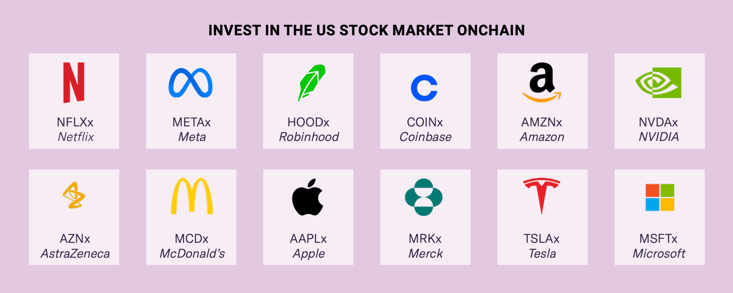 Source: Cointelegraph, Tokenized stock trading live on Kraken, Bybit and Solana’s DeFi ecosystem, June 30, 2025. The companies shown in this example are not a buy, sell, or hold recommendation.
Platform Tilt: Focused Exposure to the Digital Rails
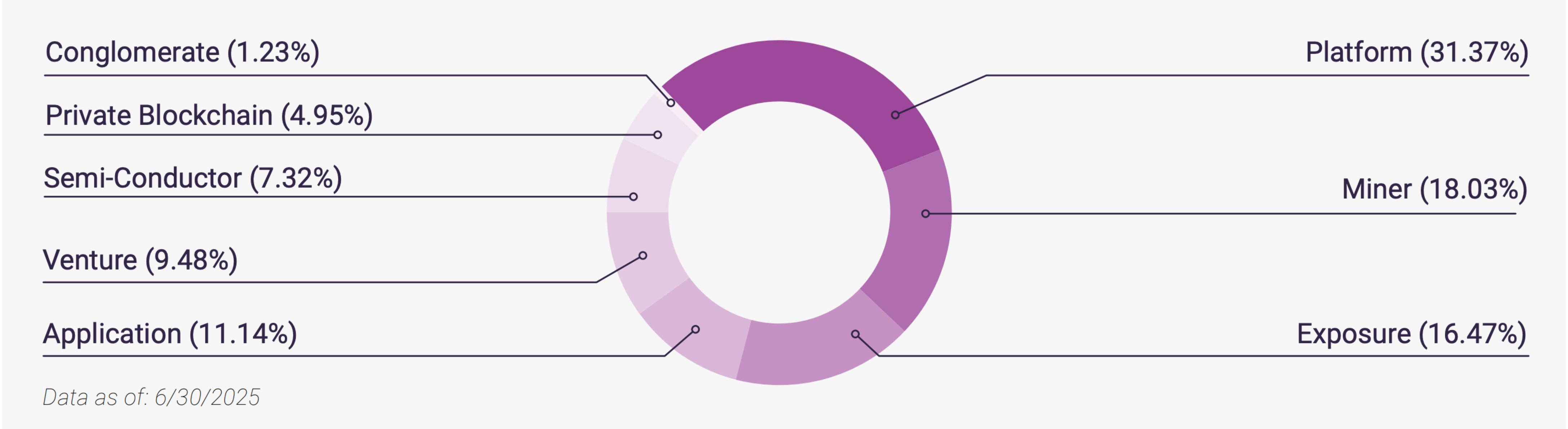
Just as the Automatic Teller Machine (ATM) revolutionized banking in the 1960s, we believe today’s platform companies—spanning asset management, payments, and brokerage—are poised to reshape global finance. BLOK allocates around 31.37% of the portfolio to platform companies, up from 27% in May.
BLOK ETF: Blockchain Industry Allocation
Today, of course, banks as “platforms” are threatened by a rapidly changing Global Payments industry that McKinsey says is worth $1.8 Quadrillion in value.1 How money is treated is changing rapidly and technology adoption today happens far quicker than in the past; especially since the younger generations such as GenZ do everything on their mobile devices. In the future, it is possible that millions of people will not use banks and be happy to be “unbanked”. This is because people can use platforms like Coinbase, Robinhood or even cold storage to serve their banking needs. Remember, if you hold your “money” in the form of a digital asset that is a bearer instrument (aka Bitcoin/cold storage) you do not have to worry about a bank default or much of the frictional costs associated with banking. For illustrative purposes we are providing a chart from the well-known venture firm, a16zCrypto, that highlights the fact that stablecoins are the “cheapest and fastest way to send a dollar” and part of the reason why we are heavily tilted towards platforms companies as a category.5
PAYMENT TYPE TRANSACTION FEE TIME TO SETTLE NOTES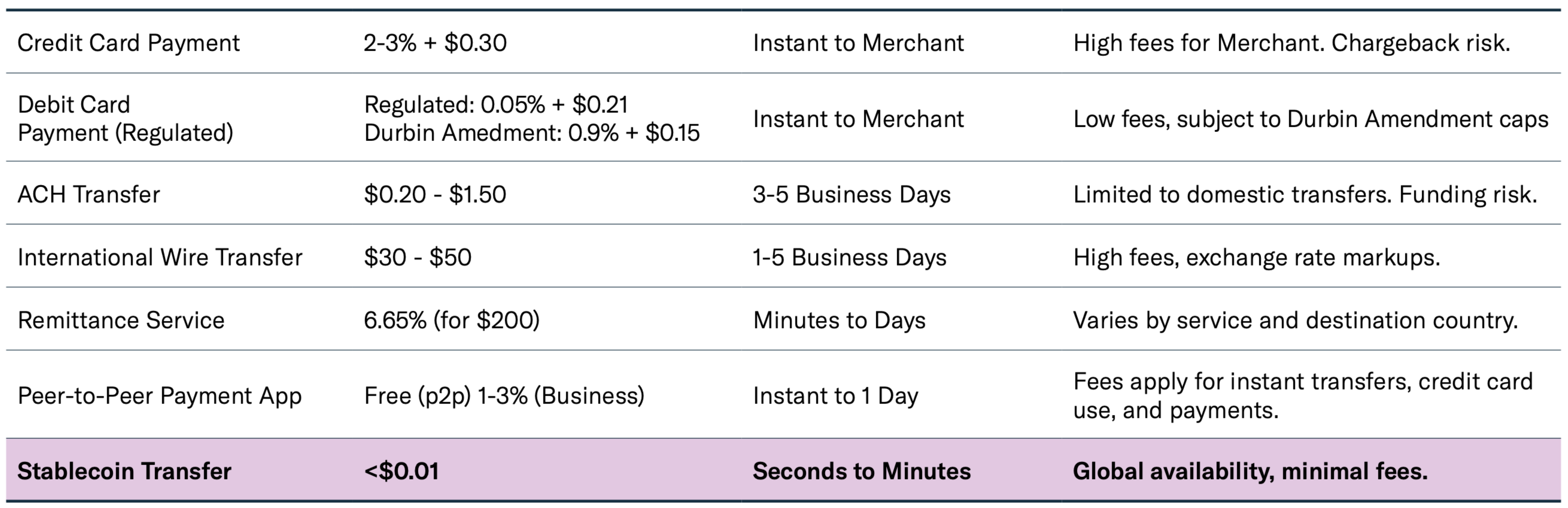 Source: a16zCrypto, How Stablecoins Will Eat Payments, Dec. 2024. Amplify ETFs and a16zCrypto are not affiliated.
Notable moves:
- New positions initiated in Circle Internet (CRCL), Shift4, and Fiserv (FI).
- These companies support or integrate stablecoin and Blockchain infrastructure, including recent partnerships with PayPal.
- While initial positions are small, we see long-term upside and are positioned to scale exposure.
Circle’s IPO and the legislative momentum around stablecoins signal future leadership in this category. As always, we remain valuation-sensitive and disciplined in position sizing—lessons learned from previous high-profile launches like Coinbase.
Transactions and Repositing:
Our approach to managing risk at the top end of our portfolio continued as we trimmed back on Metaplanet, but we also increased our exposure to Strategy (MSTR). Positions in CME Group (CME) and WisdomTree (WT) were increased and funded by some sideline cash and our holdings in Coreweave. In many ways, the deal to acquire Core Scientific by Coreweave (CRWV) was well telegraphed and we just could not justify further exposure into the potential for a deal that was clearly going to involve stock.6 Long-time investors in BLOK may recall that we were on the Core Scientific restructuring committee. In many ways, this historic role provides us with some foundational insights into the company and its culture.
The question now is whether BLOK in this second half can continue to capture the equity benefits associated with the early acceleration of disintermediation associated with the Blockchain infrastructure buildout in the Global Payment rails, a favorable capital markets outlook stimulated by liquidity and a friendly regulatory environment...
*BPs: A basis point (BP) is a unit that is equal to 1/100th of 1%.
**Schedule K-1 is a federal tax document used to report the income, losses, and dividends of a business’ or financial entity’s partners or an S corporation’s shareholders. This information does not constitute, and should not be considered a substitute for, legal or tax advice.
1McKinsey, Global Payments in 2024 Report, Oct. 2024.
2forbes.com/sites/ninabambysheva/2025/06/18/crypto-goes-corporate-as-a-new-wave-of-public-companies-buy-bitcoin/
3blog.river.com/american-bitcoin-advantage/
4cointelegraph.com/news/tokenized-stock-trading-live-on-kraken-bybit-and-solana-s-defi-ecosystem
5a16zcrypto.com/posts/article/how-stablecoins-will-eat-payments/
6investors.corescientific.com/news-events/press-releases/detail/119/coreweave-to-acquire-core-scientific
7Alpha is a measure of an investment's performance that indicates its ability to generate returns in excess of its benchmark.