



Market and Economic Update - Earnings strength, shifting Fed expectations, and active commodities shaped a volatile but constructive past month
Stocks and bonds posted gains in January, extending the positive momentum from prior years. Despite multiple bouts of volatility triggered by geopolitical developments and Federal Reserve discussions, markets demonstrated resilience. Major indices quickly recovered from short-term declines, including the S&P 500’s sharpest single-day drop since October, and went on to establish fresh record highs. A solid start to corporate earnings provided crucial support for investor portfolios throughout the month.
|
Historically, a positive January has been a strong signal: since 1950, a positive January return for the S&P 500 has led to a positive full year return 89% of the time (41 of 46 years).1 For those 41 positive years, the average return was 16.9%. |
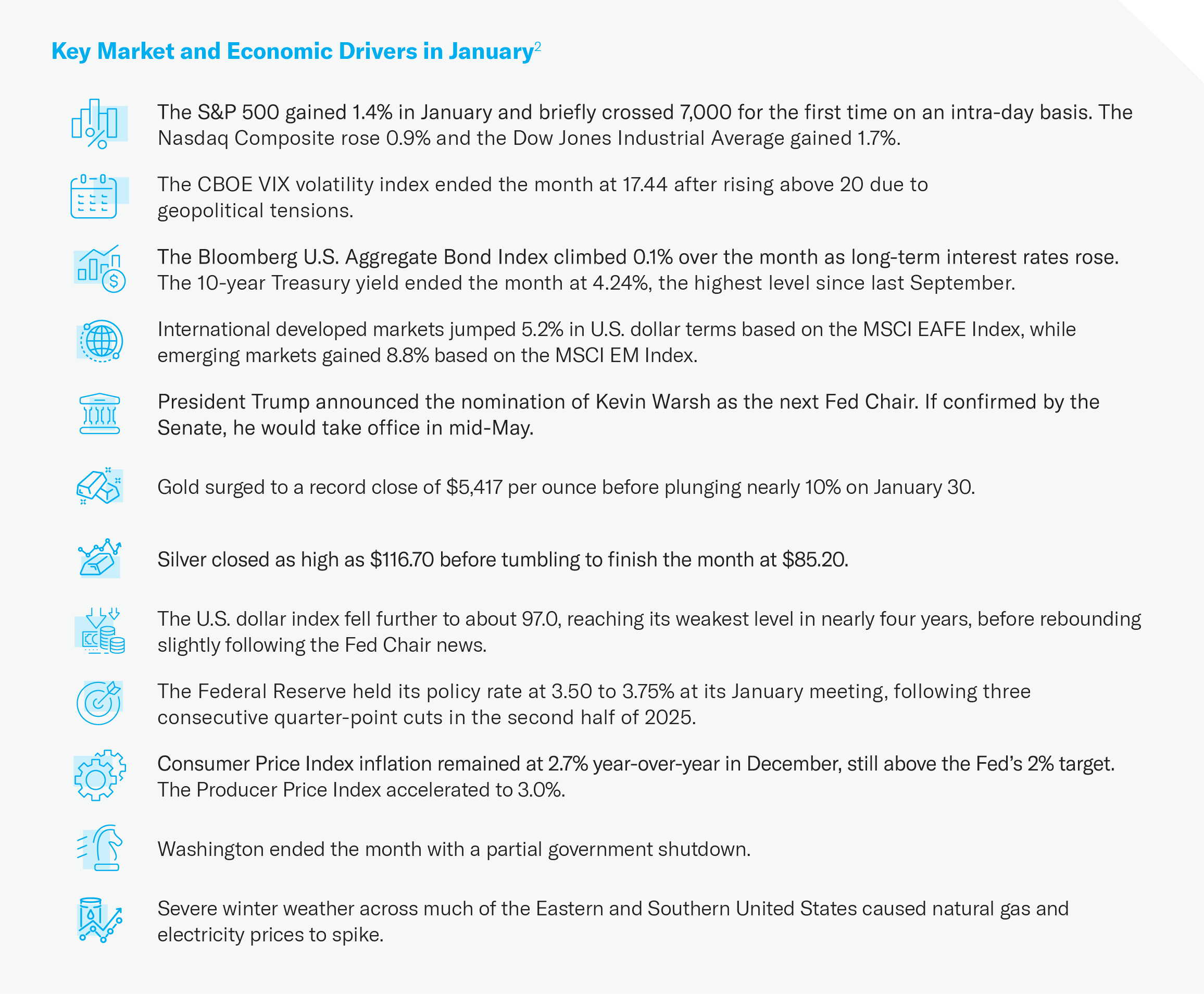
Although geopolitical developments and policy questions may generate additional volatility in 2026, we believe maintaining a well-balanced portfolio that aligns with your financial objectives remains an effective strategy.
1. January’s key market developments
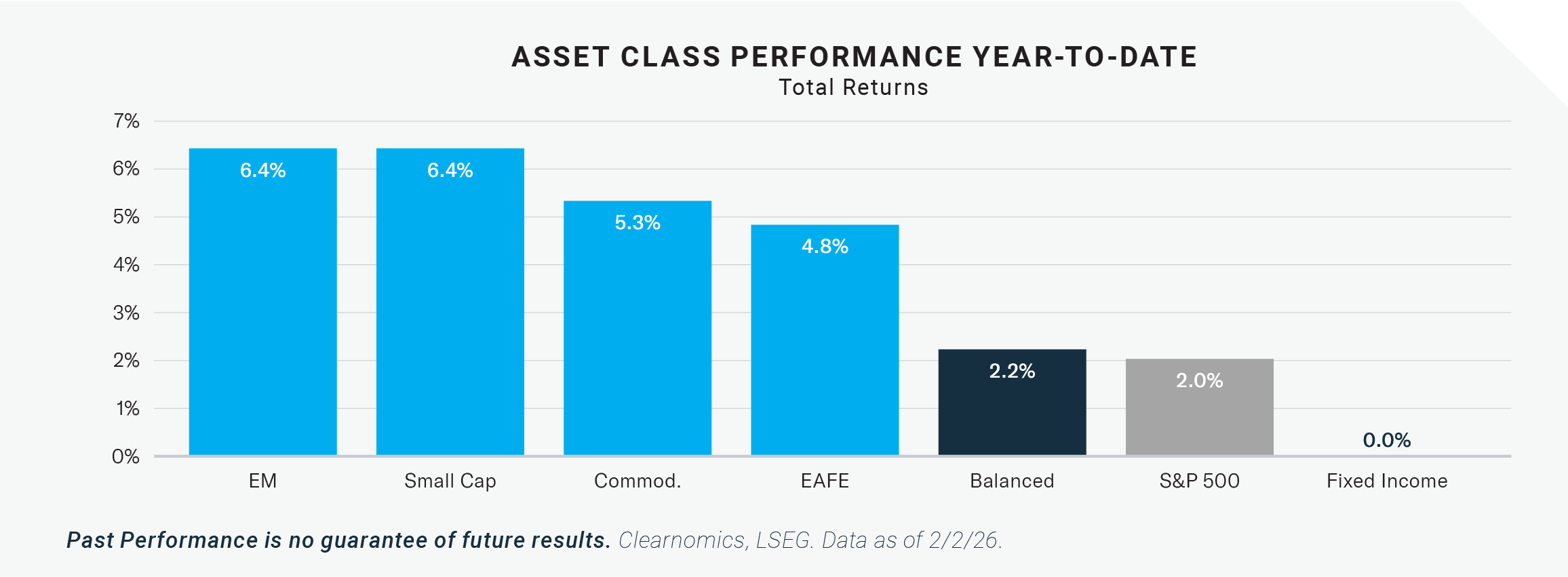
International stocks (EM, EAFE), small caps, and commodities outperformed the S&P 500 in January. Early month geopolitical tensions—including a U.S. operation in Venezuela that sparked oil market concerns, as well as friction with NATO over reported U.S. interest in purchasing Greenland—briefly weighed on sentiment and contributed to the S&P’s worst daily decline since October. Markets quickly rebounded after diplomatic progress eased tensions.
Energy is seeing increased attention as geo-political pressures, rising global consumption, stronger commodity pricing, constrained supply growth, and capital efficient producers all reinforce durable long-term demand and position the sector well for the year ahead.
Likewise, international equities are drawing renewed interest as dollar weakness concerns, improving global macro conditions, and diversification away from U.S. market concentration revive capital flows into overseas markets. We believe strength across key conduits—such as European financials, foreign semiconductor and data center leaders benefiting from AI spend, and commodity linked economies supported by metals pricing—are extending the tailwinds for international equities after a strong 2025.
2. Federal Reserve developments helped drive precious metals volatility
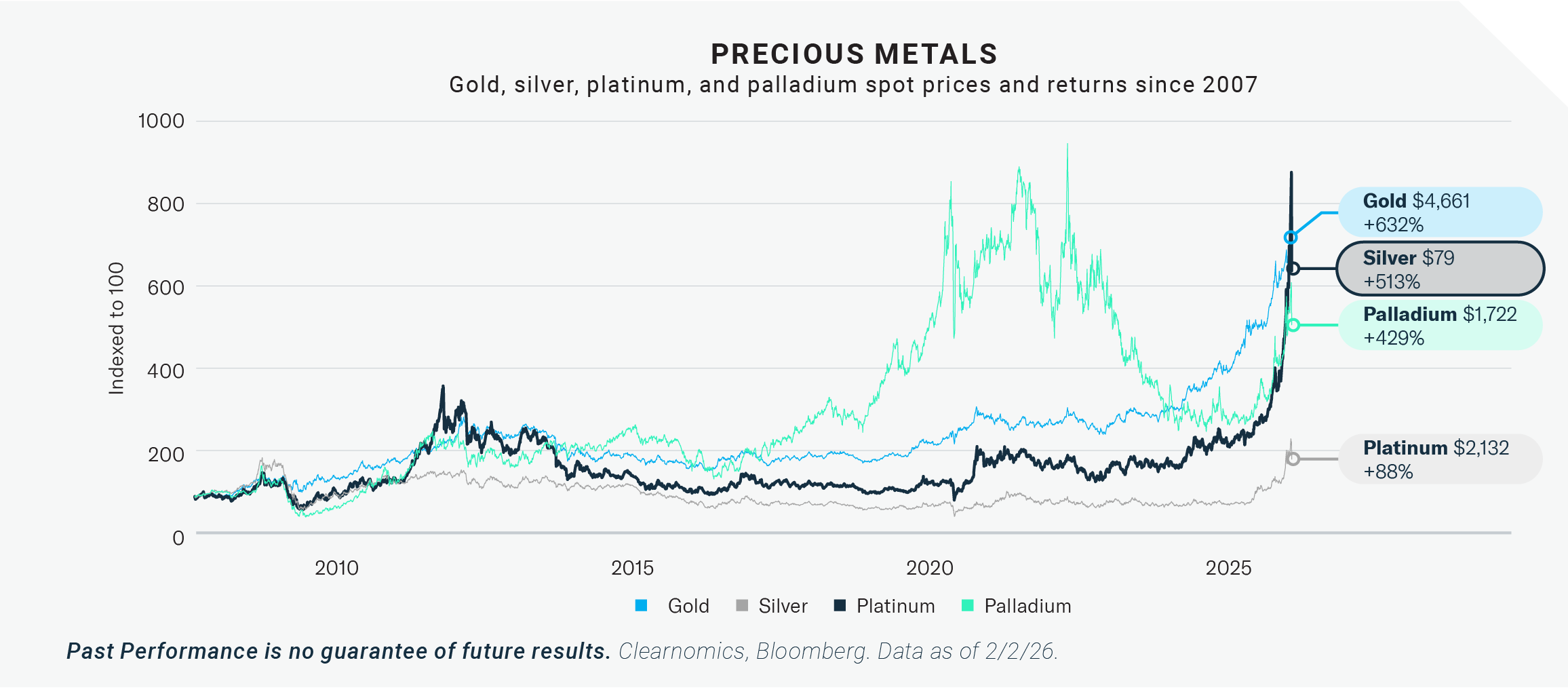
Precious metals rallied through most of January before a sharp end-of-month reversal, with silver briefly topping $120 per ounce. Part of the advance reflected the broader “debasement trade”—geopolitical risk, central bank buying, and uncertainty around future Fed leadership and policy direction. The announcement of Kevin Warsh as the intended next Fed Chair briefly eased policy anxiety and triggered a pullback across gold and silver.
But silver’s underlying case remains notably stronger and more diversified than gold’s. Its performance continues to be driven by a dual engine demand profile: safe haven and store of value flows on one side and structurally rising industrial demand on the other—spanning AI enabled electronics, solar, EVs, semiconductors, and consumer devices. This demand strength is occurring against a persistent multi-year supply deficit, creating a backdrop that has historically supported outsized moves when investor sentiment and industrial momentum align.
We believe January’s volatility is typical following rapid appreciation and does little to alter silver’s structural story. Key long-term drivers remain firmly in place:
- a sustained global supply deficit
- heightened geopolitical and macro uncertainty supporting store of value demand
- growing focus on critical minerals and resource scarcity
- accelerating electrification and technology adoption that continue regardless of short-term market swings
Silver miners—often considered higher beta expressions of these trends—remain leveraged to this multiyear setup. Overall, recent consolidation appears healthy and reinforces silver’s role as a complement to core equity and fixed income holdings, offering differentiated exposure to both industrial growth and safe haven demand.
3. Strong earnings supported market performance
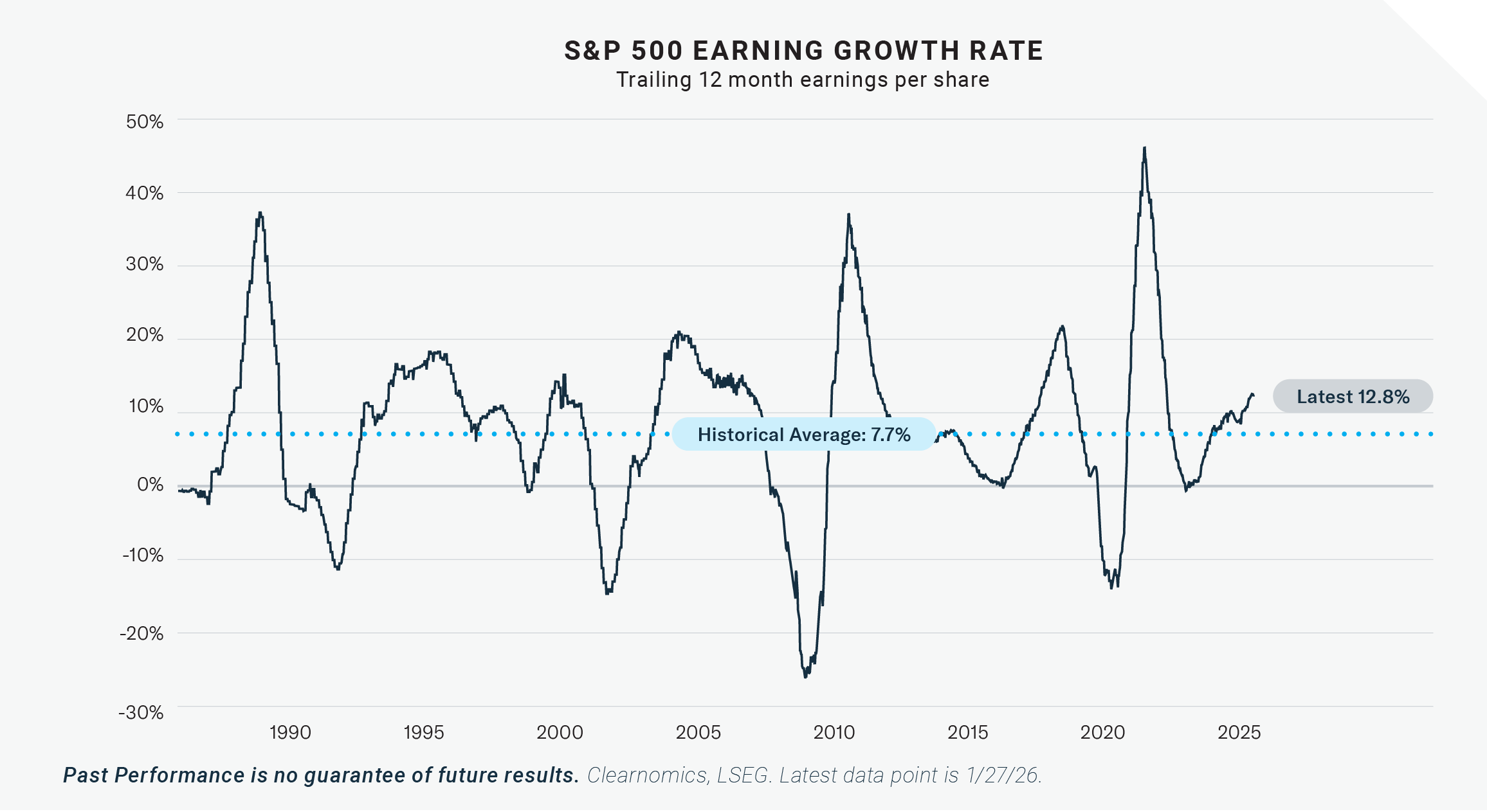
Fourth quarter earnings continued to show solid corporate momentum. With one-third of S&P 500 companies reporting, 75% beat expectations, putting earnings on track for nearly 12% growth and marking a fifth straight quarter of double-digit gains.3
While technology and AI focused firms drew significant attention, the results also highlighted the broadening of the AI trade—more companies across the AI infrastructure ecosystem, including semiconductor suppliers, hardware manufacturers, and cloud computing platforms, are now contributing meaningfully to growth.
At the same time, earnings strength continued to widen across multiple sectors as the broader economy remained resilient.
|
The Bottom Line? The key takeaway is that corporate profitability remains robust and supportive of current valuations, helping major indices stay positive despite geopolitical noise, Fed related volatility, and shifting sentiment in January. For long-term investors, this reinforces the importance of maintaining a balanced asset allocation aligned with long-term goals. |
1Carson Investment Research, FactSet 1/30/2026
2Clearnomics, 2/2/26.
3Clearnomics, Factset 2/2/26.
Indexes are unmanaged and it’s not possible to invest directly in an index. The S&P 500 Total Return Index (Large Cap) is a marketcapitalization weighted index of the 500 largest U.S. publicly traded companies. The MSCI EAFE Index is designed to measure the equity market performance of developed markets outside the U.S. and Canada. MSCI Emerging Markets (EM) Index is designed to measure large- and mid-cap representation across emerging market countries. MSCI World Small Cap Index (Small Cap) is designed to measure the performance of the small capitalization companies across developed markets globally. Bloomberg Agg Bond Index (Fixed Income) is designed to measure the performance of the U.S. investment grade bond market. MSCI World Commodity Producers Index (Commodities) is designed to measure the performance of the global opportunity set of developed commodity-producing companies. The balanced portfolio is a 60/40 historical index calculation consisting of 40% U.S. large cap., 5% small cap, 10% international developed equities, 5% emerging market equities, 35% U.S. bonds, and 5% commodities.
The CBOE Volatility Index (VIX) is a measure of the market’s expectation of volatility over the next 30 days. The Consumer Price Index (CPI) is a measure of the average change over time in the prices paid by consumers for a basket of goods and services. The Producer Price Index (PPI) measures the average change over time in the selling prices received by domestic producers for their output. The U.S. Dollar Index is a measure of the value of the U.S. dollar relative to a basket of six major foreign currencies.
Trailing 12 month earnings per share) is a financial metric that shows how much profit a company earned per share over the most recent 12 consecutive months.
Carefully consider the Fund’s investment objectives, risks, charges, and expenses before investing. This and other information can be found in the Fund’s statutory and summary prospectuses, which may be obtained at AmplifyETFs.com. Read the prospectus carefully before investing.
Investing involves risk, including the possible loss of principal. Shares of any ETF are bought and sold at market price (not NAV), may trade at a discount or premium to NAV and are not individually redeemed from the Fund. Brokerage commissions will reduce returns.
Amplify ETFs are distributed by Foreside Fund Services, LLC.