



Navigating Opportunities Amid Rotations - Market and Economic Update
February served as a reminder that markets rarely move in a straight line. Following January’s positive momentum, which had carried major indices to record highs, sentiment shifted in response to a landmark Supreme Court decision on tariffs, uncertainty surrounding artificial intelligence, and significant escalations in the Middle East. At the same time, international equities and small cap stocks continued to lead, and bonds posted further gains — underscoring the value of maintaining a well-balanced portfolio.
Although headlines can fuel short-term volatility, the broader economy remains on solid footing and corporate earnings continue to expand.
Key Market and Economic Highlights
-
On February 20, the Supreme Court ruled against the administration’s use of IEEPA-based reciprocal tariffs, prompting a shift toward alternative trade laws.
-
On February 28, the U.S. and Israel launched military strikes against Iran, including the compound of Iran’s Supreme Leader, who has been reported killed.
-
The CBOE VIX volatility index climbed to 19.9 at month-end, driven by AI-related concerns and uncertainty around trade policy.
-
International developed markets advanced 4.5% based on the MSCI EAFE Index in U.S. dollar terms, while emerging markets gained 5.4% per the MSCI EM Index. Year-to-date, these regions have returned 9.9% and 14.6%, respectively. U.S. small-cap stocks posted a gain of 0.7% based on the Russell 2000.
-
Gold ended lower at $5,279 per ounce after touching as low as $4,661 early in the month. Silver closed lower at $93.79 for the month.
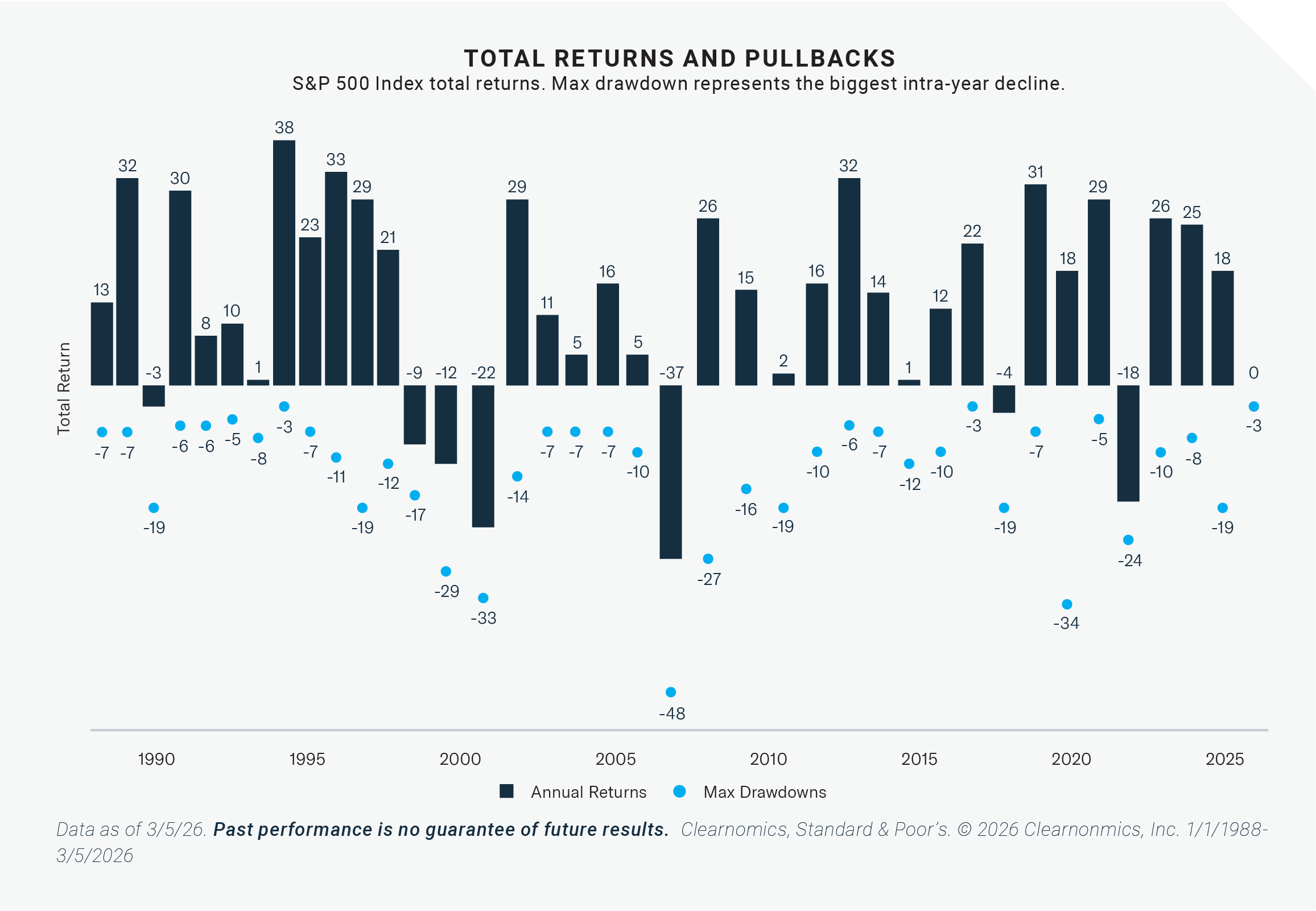
It is important to keep in mind that midterm election years have historically been plagued with volatility with an average peak to trough correction of 17.5%. However, 12 months after those lows markets historically delivered an impressive rebound of over 31% on average.1
Additionally, despite significant average intra-year drawdowns, in the past 38 years, annual total returns have been positive over 81% of the time.
Middle East Escalation and Energy Market Implications
At the end of February, the U.S. and Israel launched military strikes against Iran, marking a significant escalation in Middle East tensions. While the situation remains fluid and carries serious geopolitical consequences, investors are primarily focused on the implications for markets — particularly oil and natural gas prices.
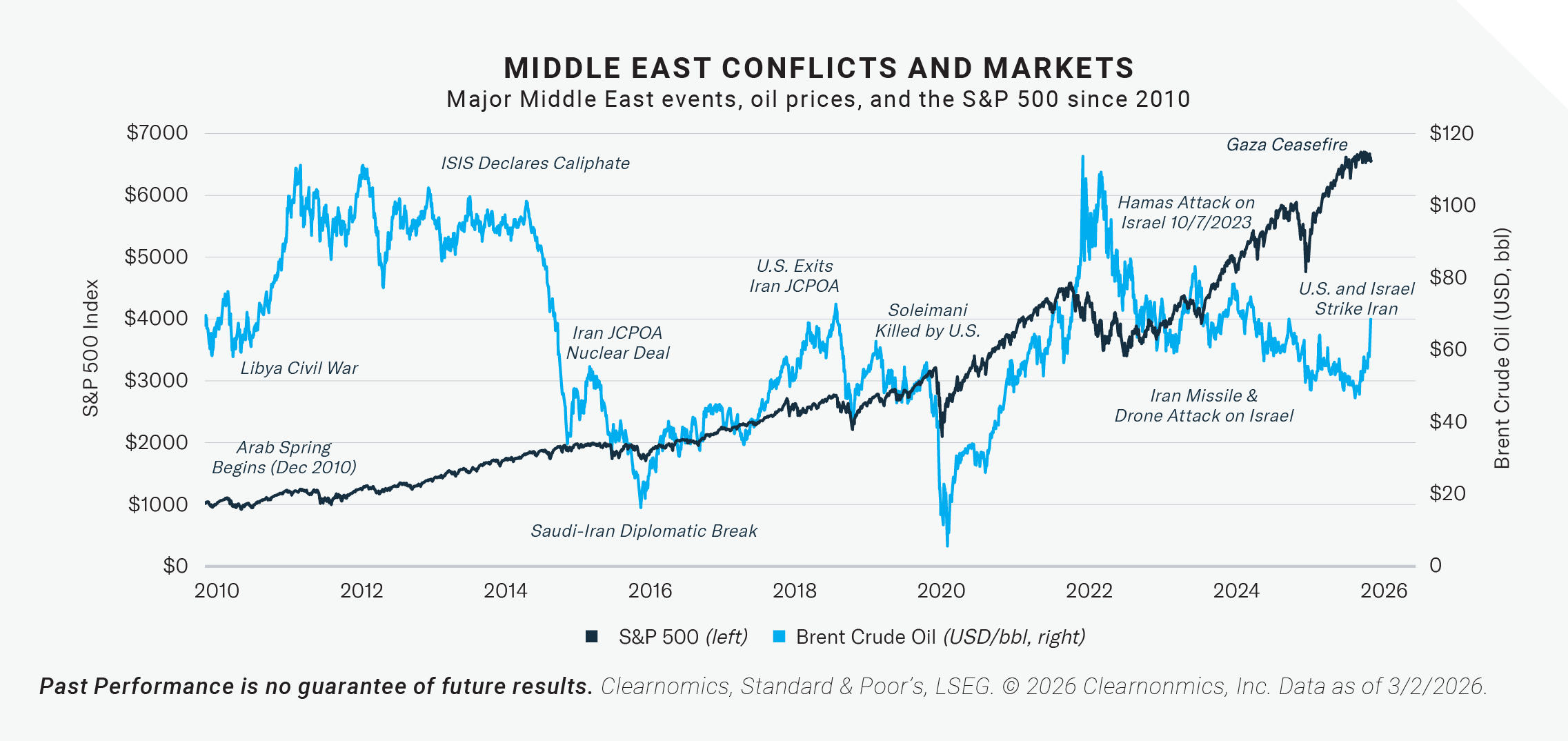
Energy markets are typically the most direct transmission channel during Middle East conflicts. Iran is a meaningful oil and gas producer and borders the Strait of Hormuz, through which roughly one third of global seaborne oil exports and one fifth of natural gas shipments pass. As a result, even the risk of disruption can push global energy prices higher. Oil prices rose following the escalation, with WTI crude moving into the low $70s and Brent approaching $80 per barrel.
Current prices remain well below the 2022 peak, and the U.S. is now the world’s largest producer of oil and natural gas, providing some insulation from foreign supply disruptions. At the same time, global demand for energy and critical resources — including oil and natural gas — continues to be supported by longer‑term structural forces such as the need for reliable base‑load power, infrastructure investment, and electrification.
Importantly, the case for maintaining exposure to these areas does not rely solely on acute geopolitical stress, but also on their role within a diversified portfolio across a range of macroeconomic outcomes. As a result, energy and resource‑oriented equities may play
a constructive role within portfolios.
The bottom line: We believe the Iran conflict could contribute to near term volatility in oil and natural gas markets, and this demand may be reinforced by long-term structural trends.
How the Supreme Court Ruling Reshaped Trade Policy
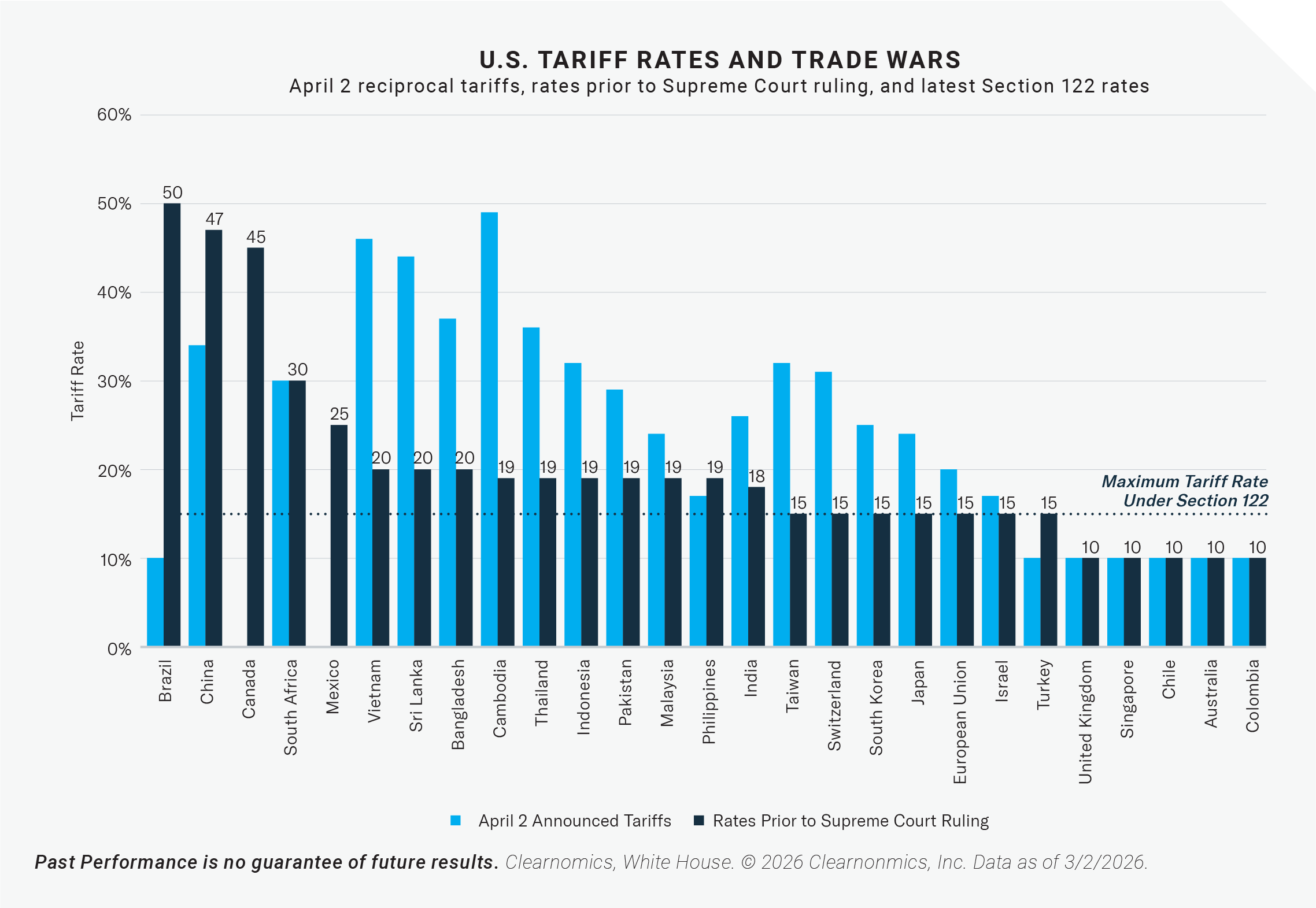
The most consequential policy development in February came on February 20, when the Supreme Court struck down the administration’s tariff framework implemented under the International Emergency Economic Powers Act (IEEPA). The ruling carries meaningful implications, including the potential for tariff refunds to businesses and consumers. In response, the White House quickly reinstated tariffs under Section 122 of the Trade Act of 1974, allowing duties of up to 15% for 150 days, effective February 24. Additional measures under Sections 301 and 232 are also expected, underscoring the administration’s continued focus on trade enforcement.
For investors, the key takeaway is that while the legal authority has changed, the broader trade policy direction remains intact. Ongoing uncertainty is likely to contribute to market volatility, though history suggests markets adapt as companies adjust supply chains and pricing.
Treasury yields reflected some of this uncertainty, with the 10-year yield briefly dipping below 4% for the first time since November. This dynamic provided a tailwind for fixed income portfolios in February and reinforces why bonds continue to serve a meaningful role in balanced investment strategies.
Bottom line?
While the legal framework for tariffs has shifted, trade policy uncertainty remains a source of volatility, reinforcing the importance of diversification and the stabilizing role of fixed income in balanced portfolios.
Balancing AI Optimism with Valuation Concerns
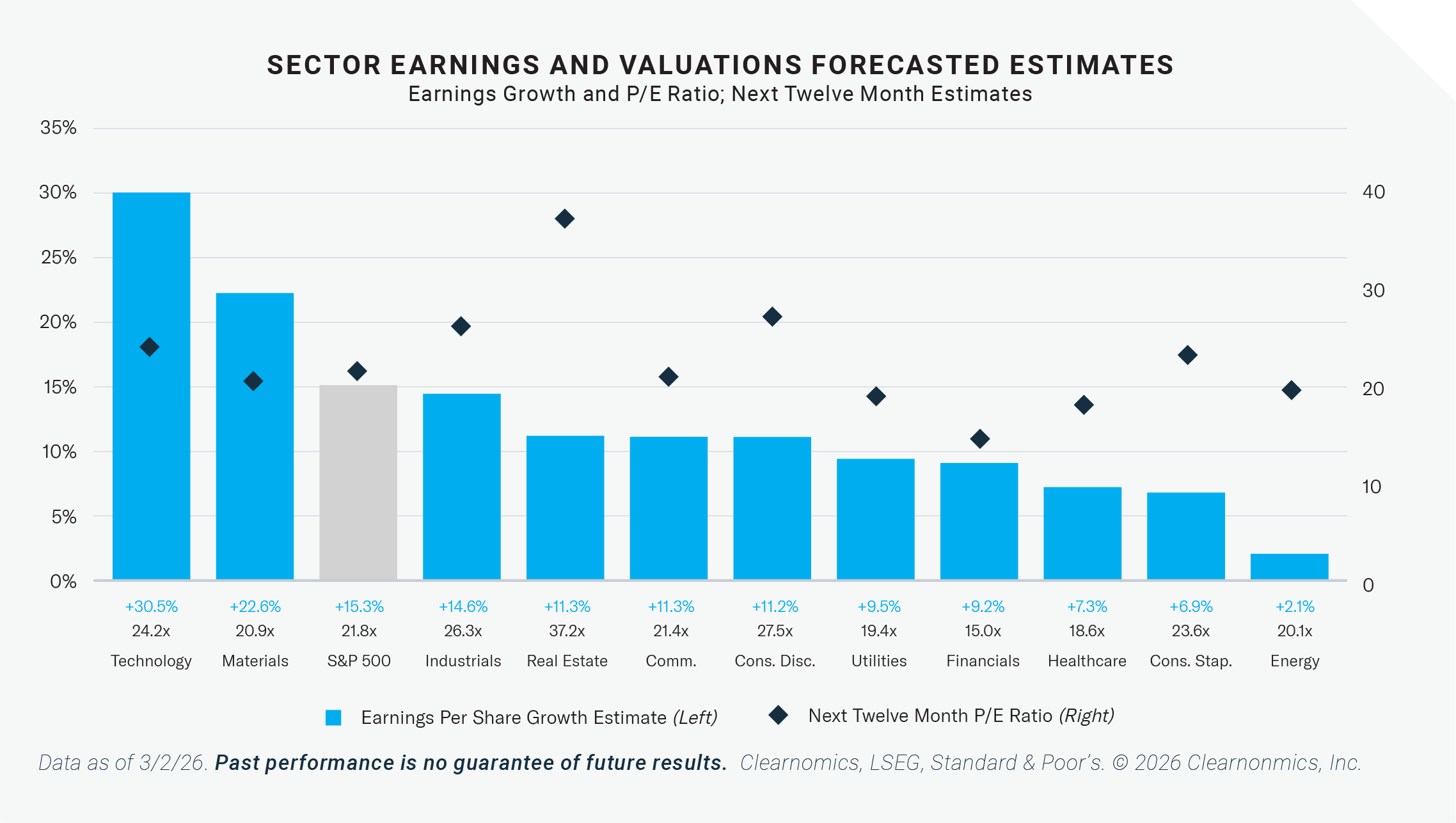
Artificial intelligence remained a dominant theme in February, though the conversation shifted from lofty valuations to a more nuanced debate about the pace and scope of disruption to existing business models. Some investors have grown concerned that AI agents could compress software margins, accelerate white-collar job displacement through automation, and upend traditional industries more rapidly than anticipated.
These concerns have contributed to a notable rotation in market leadership. Investors have been moving away from mega-cap technology stocks and toward sectors perceived as more resilient to disruption, such as energy, materials, scarce resources, and industrials. This transition — sometimes described as a shift toward "heavy assets, low obsolescence" (HALO) companies — helps explain why the Nasdaq lagged while other areas of the market advanced.
Bottom line?
While market volatility can be unsettling, this rotation represents a constructive development for balanced portfolios. The rotation away from mega cap technology toward more asset intensive, less disruption prone sectors reflects a healthy broadening of market leadership rather than a deterioration in underlying fundamentals.
International Equities and Small Caps Extended Their Leadership
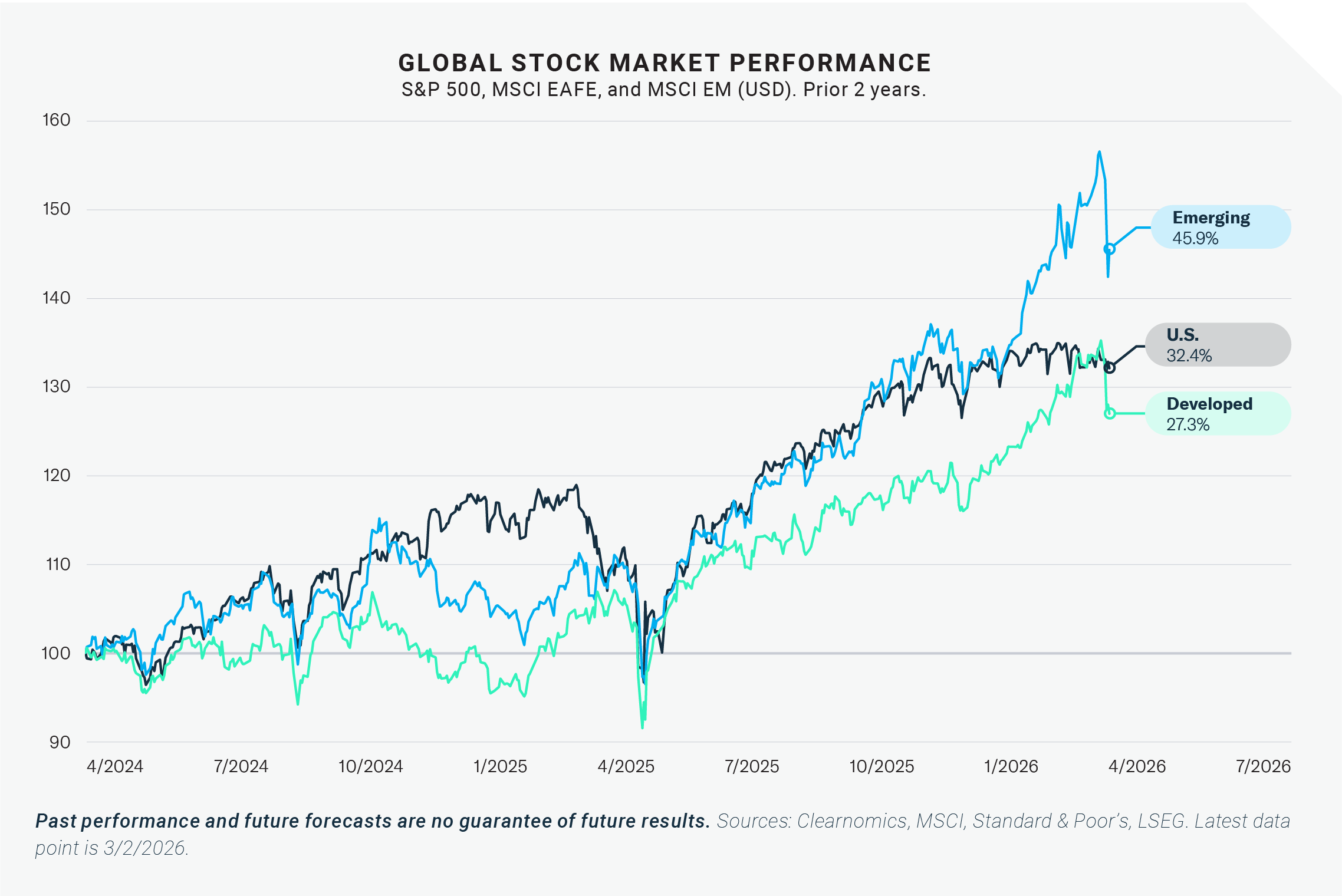
One of the most notable trends in February was the continued outperformance of asset classes beyond U.S. large-cap equities. International developed markets rose nearly 5% for the month, while emerging markets gained more than 5%. U.S. small caps recorded their strongest monthly performance since August, with the Russell 2000 surging roughly 5% year-to-date, well ahead of the S&P 500.
This broadening of market returns holds significance for diversified investors. After several years in which a handful of large U.S. technology companies drove the bulk of market gains, the rotation toward international equities, small caps, and cyclical sectors suggests that opportunities are emerging across a wider range of assets. A softer U.S. dollar earlier in the year has also provided a boost to international returns when translated back into U.S. dollar terms.
Precious metals also maintained their strong momentum, with gold and silver gaining 6.8% and 8.1%, respectively. These gains reflect a combination of geopolitical uncertainty, central bank buying activity, and concerns about fiscal deficits. Silver also benefits from structural tailwinds, as growing industrial demand—particularly from solar, semiconductors, and electronics—continues to expand.
|
The Bottom Line? While U.S. large-cap equities faced pressure from AI valuation concerns and trade uncertainty, strength in international stocks, small caps, commodities, precious metals, and bonds reinforced the benefits of diversification. Middle East tensions and tariff headlines may continue to drive near-term volatility, but a broadening of returns across asset classes is a healthy development for long-term investors. |
1Carson Investment Research, Market Commentary What May Lie Ahead for Stocks in 2026, 11/16/25
Indexes are unmanaged and it’s not possible to invest directly in an index. The S&P 500 Total Return Index is a market-capitalization-weighted index of the 500 largest U.S. publicly traded companies. CBOE Volatility Index (VIX) is a measure of implied volatility, based on the prices of a basket of S&P 500 Index options with 30 days to expiration. The MSCI EAFE Index is designed to measure the equity market performance of developed markets outside the U.S. and Canada. MSCI Emerging Markets (EM) Index is designed to measure large- and mid-cap representation across emerging market countries. The small cap equity is represented by the Russell 2000 Index, which measures the performance of small-cap segment of the US equity universe. 10-year Treasury is represented by the Bloomberg US Treasury Bellwethers 10 Year Index that measures the on-the-run (most recently auctioned) U.S. Treasury bond with 10 years’ maturity.
Carefully consider the Fund’s investment objectives, risks, charges, and expenses before investing. This and other information can be found in the Fund’s statutory and summary prospectuses, which may be obtained at AmplifyETFs.com. Read the prospectus carefully before investing.
Investing involves risk, including the possible loss of principal. Shares of any ETF are bought and sold at market price (not NAV), may trade at a discount or premium to NAV and are not individually redeemed from the Fund. Brokerage commissions will reduce returns.
Amplify ETFs are distributed by Foreside Fund Services, LLC.