



Context for investors navigating a turbulent start to 2026 - Market and Economic Update
The first quarter of 2026 serves as a powerful reminder of why preparation matters in financial planning and investing. Following strong gains in 2025, markets confronted a combination of geopolitical shocks, rising oil prices, and renewed economic uncertainty. The conflict in Iran, which began in late February, dominated market headlines, driving oil prices sharply higher and triggering the year’s first notable pullback. A ceasefire is currently in play, though the situation continues to develop.
Despite this turbulence, markets have performed well over the past twelve months, with energy and defensive sectors providing meaningful support to portfolios. Looking ahead, new questions will likely emerge, including a leadership transition at the Federal Reserve and the midterm election later in the year. For long-term investors, Q1 2026 reinforces that markets rarely rise in a straight line and that sound investing principles matter most during periods of peak uncertainty.
Key Market and Economic Highlights
-
The S&P 500 experienced a total return of -4.3% in Q1, the Nasdaq -7.0%, and the Dow Jones Industrial Average -3.2%.
-
The Bloomberg U.S. Aggregate Bond Index was flat for the first quarter of 2026. The 10-year Treasury yield ended the quarter at 4.3% after falling as low as 3.9% at the end of February.
-
Developed market international stocks (MSCI EAFE) were down -1.1% and emerging market stocks (MSCI EM) declined -0.1% over the quarter, both on a total return basis in U.S. dollar terms.
-
Oil prices spiked with Brent crude reaching $118 per barrel at the end of March after beginning the year under $61. WTI ended the quarter at $101 per barrel.
-
The U.S. Dollar Index (DXY) strengthened slightly end the quarter at 99.96
- February inflation showed headline CPI rising 2.4% year-over-year and core CPI climbing 2.5%. The core PCE price index, the Fed’s preferred measure, rose 3.1% year-over-year in January.
- The Federal Reserve kept rates unchanged within a range of 3.50% to 3.75% at both meetings during the first quarter.
Markets experienced the first pullback of the year
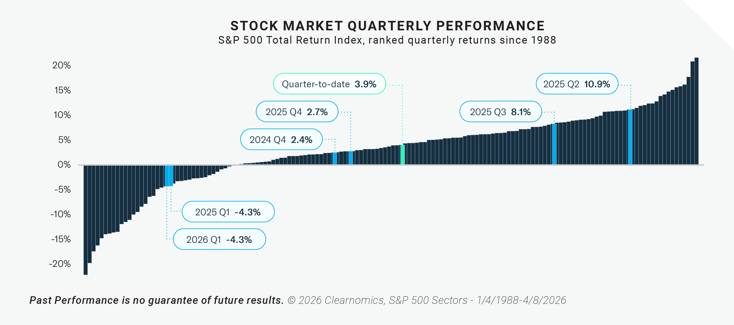
There are natural parallels between Q1 2025 and Q1 2026, as both periods were shaped by global concerns and both resulted in an identical S&P 500 pullback of 4.3%. Last year’s volatility stemmed from tariffs, while this year’s reflects conflict in the Middle East — yet the effect on investor sentiment has been remarkably similar. When uncertainty rises, short-term market swings in response to headlines are to be expected.
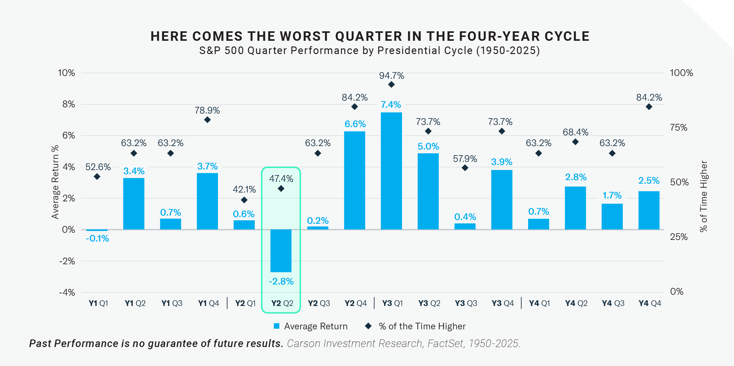
Moreover, midterm election years have historically struggled through the middle part of the year, with the second quarter among the weakest periods, with an average return of -2.8%, followed by stronger fourth-quarter performance.
History shows that pullbacks are a normal and unavoidable part of investing. Since 1980, the S&P 500 has averaged an intra-year drawdown of roughly 15%, even though markets have posted positive returns in more than two-thirds of all years. A typical year sees four or five pullbacks of five percent or more. Despite six such pullbacks in 2025, the S&P 500 still finished that year with an 18% total return. The key insight is that rebounds often occur when investors least expect them, reinforcing the value of staying invested through periods of short-term uncertainty.
Geopolitics, Oil Prices, and Inflation
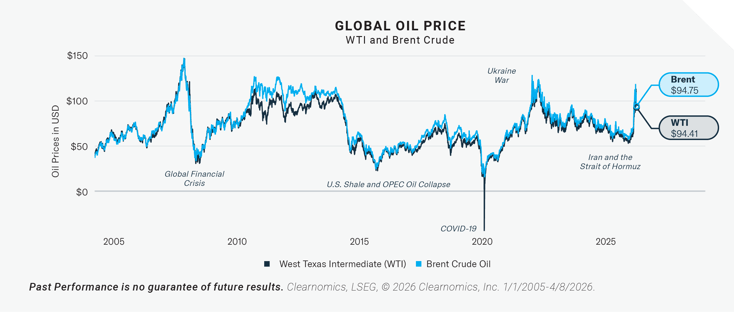
Geopolitical conflict, particularly in the Middle East, has been the primary source of market uncertainty, with the recent conflict involving Iran driving a sharp rise in oil prices. Disruptions to the Strait of Hormuz, which transports roughly 20% of global oil supply, pushed Brent crude to $118 per barrel and lifted WTI above $100, the highest levels since the war in Ukraine. These moves sent U.S. gasoline prices above $4 per gallon, a more than $1 increase in roughly a month.
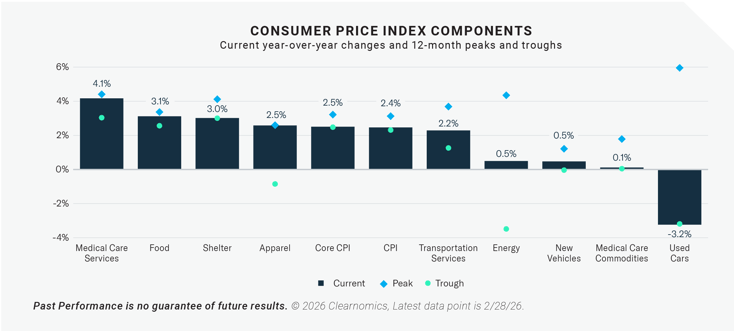
Higher energy prices affect the economy both directly, through gasoline costs, and indirectly, by raising transportation, manufacturing, and food prices. Even if the spike proves short-lived, energy’s outsized and unavoidable role in consumer spending is expected to push headline inflation higher, reducing discretionary income—particularly for lower-income households.
While economists generally view these supply-side shocks as temporary—oil prices have historically eased once geopolitical tensions subside—the near-term inflation impact complicates Federal Reserve decision-making. Markets briefly priced in a higher probability of rate hikes before shifting back toward expectations that policy rates may remain on hold. These geopolitically driven swings in inflation and rate expectations add uncertainty for businesses and make longer-term economic planning more challenging.
Sector Performance has diverged
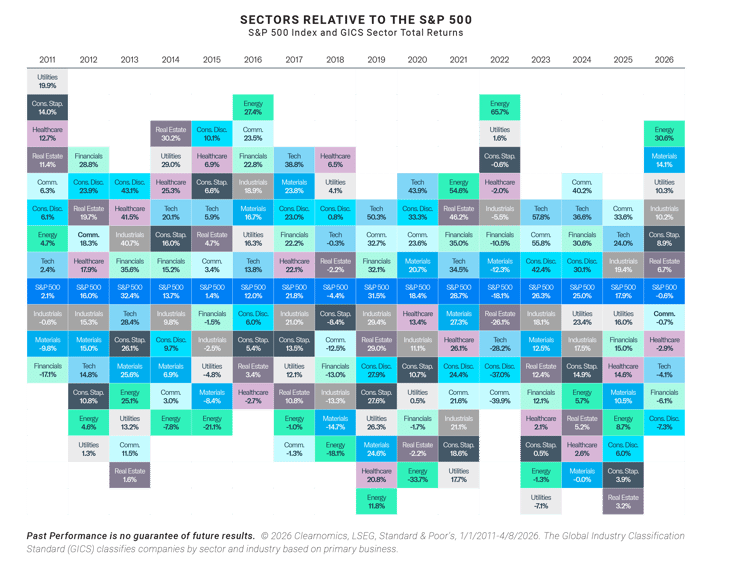
While the overall S&P 500 has pulled back, sector-level performance tells a more nuanced story. Six of the eleven S&P 500 sectors are positive for the year, and the gap between the best and worst performing sectors widened to nearly 50 percentage points in Q1. Energy has been the clear standout, gaining nearly 40% through the end of March, while Consumer Staples, Utilities, Materials, and Industrials have also shown strength as investors favored more defensive areas of the market.
By contrast, the Information Technology sector declined approximately 9%, and many mega-cap technology stocks have underperformed — a notable shift from the prior few years when a small group of large technology companies drove the majority of market gains. As the accompanying chart illustrates, sector leadership rotates based on market and economic conditions, which is why a well-balanced portfolio may be better positioned to navigate varying environments.
|
The Bottom Line? Geopolitical shocks and rising oil prices made for a volatile start to 2026, but diversified portfolios and sound investment discipline continued to do their job. Periods of uncertainty are inevitable—and they remain a reminder of why long-term planning matters most. |
Indexes are unmanaged and it’s not possible to invest directly in an index. The S&P 500 Total Return Index is a market-capitalization-weighted index of the 500 largest U.S. publicly traded companies. CBOE Volatility Index (VIX) is a measure of implied volatility, based on the prices of a basket of S&P 500 Index options with 30 days to expiration. The MSCI EAFE Index is designed to measure the equity market performance of developed markets outside the U.S. and Canada. MSCI Emerging Markets (EM) Index is designed to measure large- and mid-cap representation across emerging market countries. The small cap equity is represented by the Russell 2000 Index, which measures the performance of small-cap segment of the US equity universe. 10-year Treasury is represented by the Bloomberg US Treasury Bellwethers 10 Year Index that measures the on-the-run (most recently auctioned) U.S. Treasury bond with 10 years’ maturity.